The Journal
How to Buy and Collect Contemporary Abstract Art
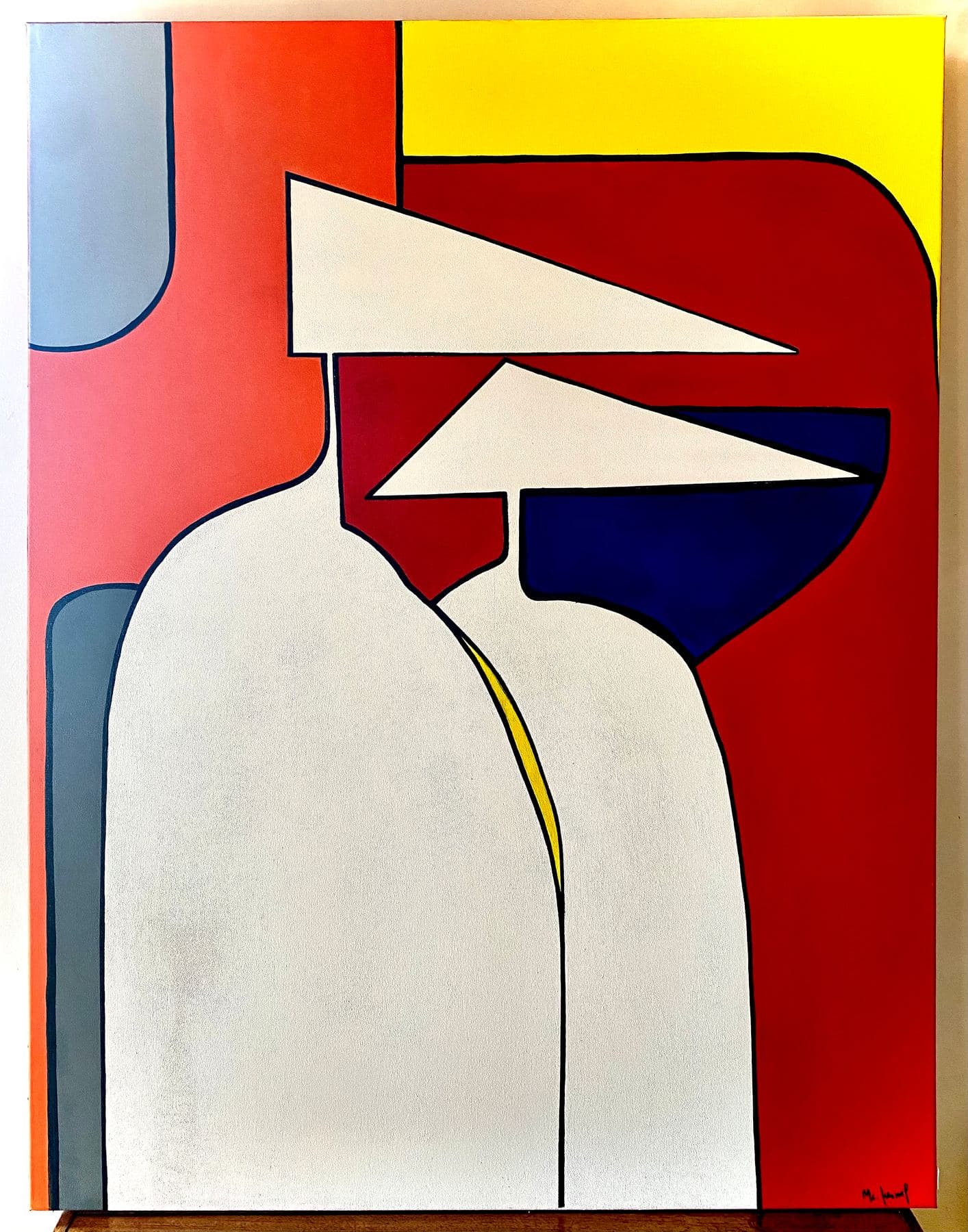
Original or reproduction? Certificate of authenticity? Emerging artist or established name? As a painter who sells her own work directly, I share the questions worth asking before a first purchase.
"Is this an original or a reproduction?" "How do I know I'm making the right choice?" Those are the two questions I hear most often at exhibitions, even before anything about technique or inspiration. A first purchase of abstract art can feel intimidating: the vocabulary of the art market seems reserved for insiders, and the price of a canvas can be hard to make sense of. Here, from the perspective of an artist who has sold her own canvases directly since 2021 — across France, Spain and Andorra — are a few concrete pointers for buying with confidence, whether you've fallen for a piece at a show or are just starting to build a collection.
Original work or reproduction: what you're actually buying
Before talking about taste or budget, it helps to be clear on what's in front of you. An original work is a unique, handmade piece — in my case, acrylic, often built up with a palette knife — that exists in a single copy. A limited edition reproduces a work digitally in a fixed, numbered and signed print run. A poster or generic reproduction, meanwhile, has neither rarity nor material presence: it's a printed image, with no relief and no trace of the painter's hand. All three have their place depending on budget and purpose, but their value — sentimental as much as financial — isn't comparable. An informed purchase always starts with knowing exactly which of the three you're looking at.
Established names and emerging artists: a two-speed market
The art market runs on two very different registers. On one side, artists with an established market presence, tracked at auction, whose prices reflect a career already validated by institutions and the secondary market. On the other, emerging or mid-career artists, whose work is mostly discovered in the studio, at regional exhibitions, or directly through them — as with my own shows in Madrid or at the Museu de la Moto in Canillo, Andorra. Buying from an emerging artist means accepting some uncertainty — tomorrow's market value is written nowhere — but it also means more accessible prices and a direct relationship with the person who painted the canvas. My advice, after several years selling my own work: buy first for the canvas itself, for what it gives you day to day on a wall. If its value happens to rise later, treat that as a bonus, never a certainty.
Five things to look at before buying an abstract work
- —Composition — the balance of solids and voids, the geometric or organic structure of the canvas: does it hold up from across the room and up close?
- —Material and technique — paint thickness, knife or brush work, the quality of the finish; our guide to palette knife painting details what to look for on a textured canvas
- —Consistency of practice — a recognisable visual signature across works, a verifiable exhibition history, rather than an isolated piece with no context
- —Condition — clean edges, a solid stretcher, no undisclosed restoration, an even surface with no cracking
- —Personal resonance — beyond technical criteria, a work that keeps holding your attention after several days is often the best sign of all
Authenticity, certificates and provenance: the questions worth asking
Before closing a purchase, a few simple questions can save you from unpleasant surprises:
- —Does the work come with a certificate of authenticity signed by the artist, stating title, year, dimensions and medium?
- —Will you receive a detailed invoice with the artist's or gallery's details at the time of purchase?
- —Is the provenance clear — direct from the artist, an exhibition, a gallery — and verifiable?
- —Has the work undergone any restoration not disclosed by the seller?
- —Are shipping, framing or delivery terms clarified before you buy?
Buying directly from the artist: my experience across France, Spain and Andorra
Since picking up painting again in 2020 and my first public exhibition in Puylaurens in 2021, I've sold my canvases directly — at exhibitions in the Tarn, in Toulouse, in Madrid and in Canillo, Andorra, as well as through my website. That direct relationship changes the nature of the purchase: you can ask me about a canvas's origin, its technique, its format, before deciding — with no intermediary and no gallery margin. That's how a piece like Jumeaux, a large 160×90 cm canvas shown in my earliest exhibitions, found its way into a private collection: it went to a collector who had seen it at a show before deciding to buy.
A work doesn't find its true place on a wall — it finds it in the eyes of whoever chooses to live with it.
If you'd like to see which canvases are currently available, the Full Collection features more than forty original works, and the News page traces my past and upcoming exhibitions across France, Spain and Andorra — feel free to get in touch directly with any question about a specific piece.
Tags
Frequently Asked Questions
Do I need a certificate of authenticity to buy an original painting?+
Yes, it's strongly recommended. A certificate signed by the artist, stating the title, year, dimensions and medium, protects the buyer and makes any future resale easier. I provide this document with every canvas I sell.
What's the difference between buying from a gallery and buying directly from the artist?+
A gallery brings curation, visibility and often an added layer of guarantee, in exchange for a commission that raises the final price. Buying directly, as at my exhibitions or through my website, means speaking with the person who painted the canvas and usually paying a price with no intermediary's margin.
Is buying an emerging artist's work a good investment?+
There's no guarantee a work's value will rise, and I'd be wary of anyone who promises otherwise. What is certain is the immediate pleasure of living with a one-of-a-kind piece. Always treat buying art first and foremost as an aesthetic and personal choice, never as a guaranteed financial investment.
How do you verify a work's provenance before buying it?+
Ask where the canvas comes from — the artist's studio, an exhibition, a gallery — and whether that can be confirmed by an invoice or certificate. Clear, documented provenance is a mark of seriousness, whether the work is by an established or an emerging artist.
What documents should I receive when I buy an original work?+
At minimum, a certificate of authenticity and a detailed invoice stating the title, year, dimensions and medium. These are what guarantee the work's traceability over time, particularly for resale or insurance.
Discover the works
Browse the full collection of original abstract paintings by M. C. Lamamie de Clairac.
View the Collection →