The Journal
Who Is M. C. Lamamie de Clairac? An Artist's Portrait, From Buenos Aires to Occitanie
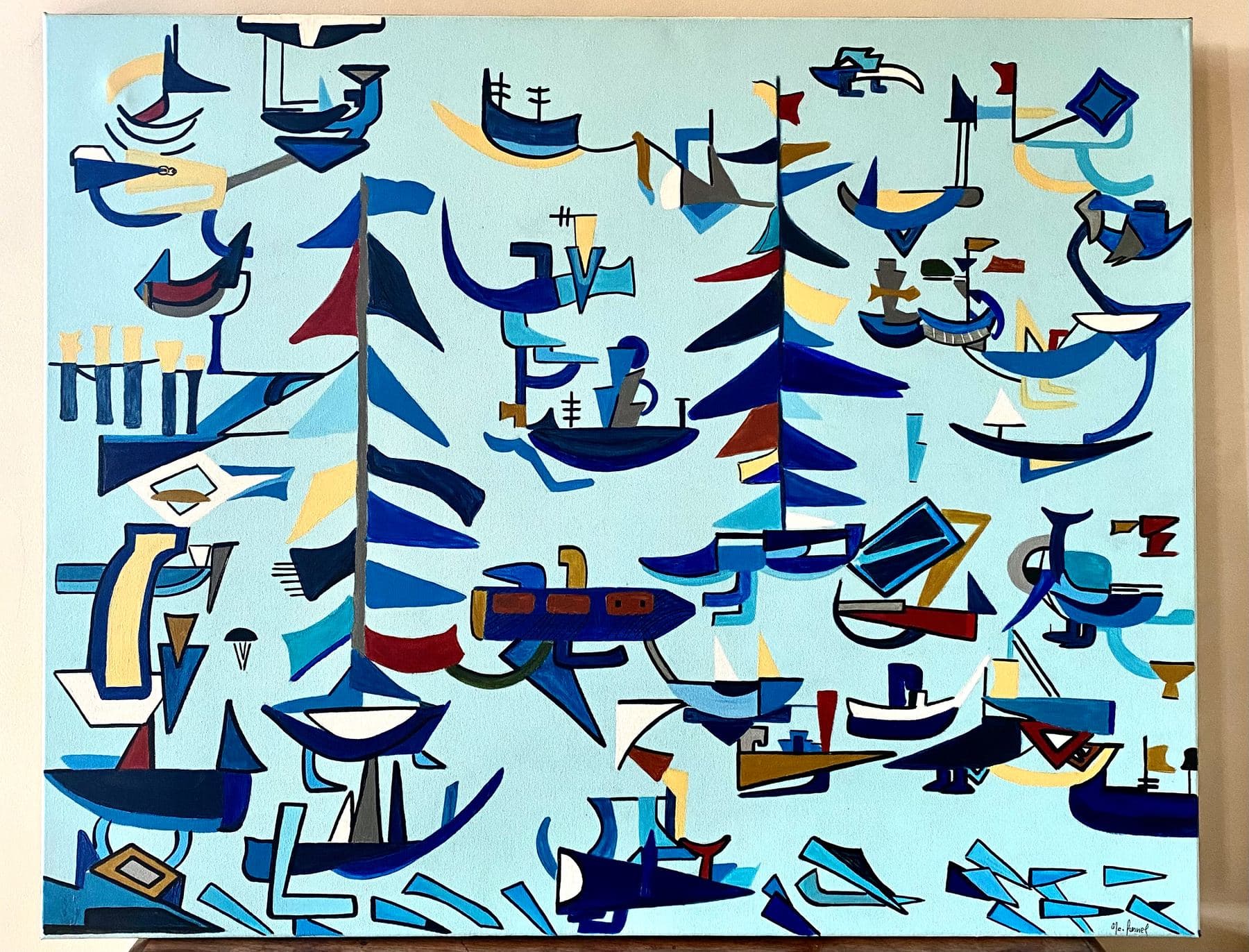
From a first drawing shown in Buenos Aires in 1982 to a canvas finished in my Tarn studio today: here is the path that shaped my eye as a painter, between Latin America and Occitanie.
"Since when do you paint?" It's almost always the first question I get asked at exhibitions — and the answer is longer than it sounds. Between a first drawing shown to the public at age nine in Buenos Aires and the canvas I'm finishing today in my Tarn studio, there was a training spread across two continents, a ten-year pause, and a return to painting that changed everything. Here, in detail, is the path that shaped my eye and my way of painting.
A calling born in Buenos Aires, in 1982
It all began with a first public presentation of drawings at the Del Lago restaurant, in Buenos Aires, Argentina, in 1982. It was a modest start — a child's drawings shown in a familiar place — but it was the first step of a relationship with art that never left me, even in the years when painting itself took a back seat.
Training between pottery, ceramics and exotic painting in São Paulo
The formal training came later, in Brazil. In 1998, I trained in pottery, painting and ceramics at Granja Julieta, in São Paulo — an apprenticeship that gave me a sense of material, gesture and volume long before I thought about geometric abstraction. Between 2001 and 2003, still in São Paulo, at Santo Amaro, I deepened my study of exotic painting techniques: that's where the vivid, contrasted palette that still runs through my canvases today first took root, inherited directly from this Latin American training period.
France, family, and a ten-year pause
In 2004, I moved to France. Creative practice moved to the background: I devoted those years to my family and to volunteer work with L'Ordre de Malte France. It isn't a minor detour in my story — it's a full decade during which the brushes stayed put away, while other priorities took up all the space. Many artists know this kind of pause; fewer expect it to last quite that long, or to lead, years later, to work that feels more assured than before.
The return to painting, in 2020
In 2020, I picked the brushes back up. That return was never a hobby rediscovered: the canvases that followed carry a confident geometric abstraction, rooted in the vibrant, exotic Latin American palette I had learned twenty years earlier in São Paulo. My first public exhibition after that ten-year pause took place in Puylaurens in 2021, at a contemporary artists' gathering — the starting point of the exhibition path built since.
Key milestones of an exhibition journey since 2021
- —2021 — Contemporary Artists Exhibition, Puylaurens: first public exhibition after returning to painting
- —2022 — Exhibition at the Halle aux Grains, Lavaur; exhibition at the Château de Saint-Félix-Lauragais; "Les 111 des Arts" artistic contest at the Hôtel Dieu Saint-Jacques in Toulouse
- —2023 — Exhibitions in Puylaurens, Lavaur and Saint-Sulpice-la-Pointe, as well as the Museu de la Moto in Canillo, Andorra
- —2023 — "Colours and Shapes" exhibition in Madrid, Spain, the Collection's first showing outside France
Twenty years separate my training in São Paulo from my return to canvas in France — and yet every painting I make today still carries the light of that first palette learned in Latin America.
What this journey reveals about my painting today
That detour through France, family and volunteer work didn't erase the Latin American training — if anything, it let it mature. When I picked painting back up in 2020, the geometric abstraction and exotic palette from my years in São Paulo came back almost untouched, but with a steadier hand — the hand of someone with nothing left to prove, only a colour left to lay down. It's this journey, more than any school, that explains why my palette-knife canvases evoke Latin America just as much as the Tarn where they're painted today. You can discover the full body of work in the Collection, organised by colourful, monochrome or figurative mood, and follow my upcoming exhibitions in France, Spain and Andorra on the News page.
Tags
Frequently Asked Questions
Who is M. C. Lamamie de Clairac?+
M. C. Lamamie de Clairac is a painter trained in Buenos Aires and São Paulo, based in the Tarn, in Occitanie. After a ten-year pause devoted to family and volunteer work, she returned to painting in 2020 and has exhibited since 2021 in France, Spain and Andorra, with a geometric abstraction shaped by her Latin American training.
Why is her painting influenced by Latin America?+
Because her artistic training took place between Buenos Aires and São Paulo: pottery, painting and ceramics in 1998, then exotic painting techniques between 2001 and 2003. That period is where the vivid, contrasted palette that still defines her canvases today comes from.
Was she always a full-time painter?+
No. After moving to France in 2004, she paused her practice for ten years to focus on family and volunteer work with L'Ordre de Malte France, before returning to painting in 2020.
Since when has she exhibited in France, Spain and Andorra?+
Her first public exhibition after returning to painting took place in Puylaurens in 2021. Since then she has exhibited in Lavaur, Toulouse, at the Château de Saint-Félix-Lauragais, in Canillo, Andorra, and in Madrid, Spain, in 2023.
Where can you see or buy work by M. C. Lamamie de Clairac?+
Her full body of original work is on view in the Collection, organised by colourful, monochrome or figurative mood. Upcoming exhibition dates in France, Spain and Andorra are published on the News page.
Discover the works
Browse the full collection of original abstract paintings by M. C. Lamamie de Clairac.
View the Collection →