The Journal
Latin American Geometric Abstraction: History, Movements and Colour
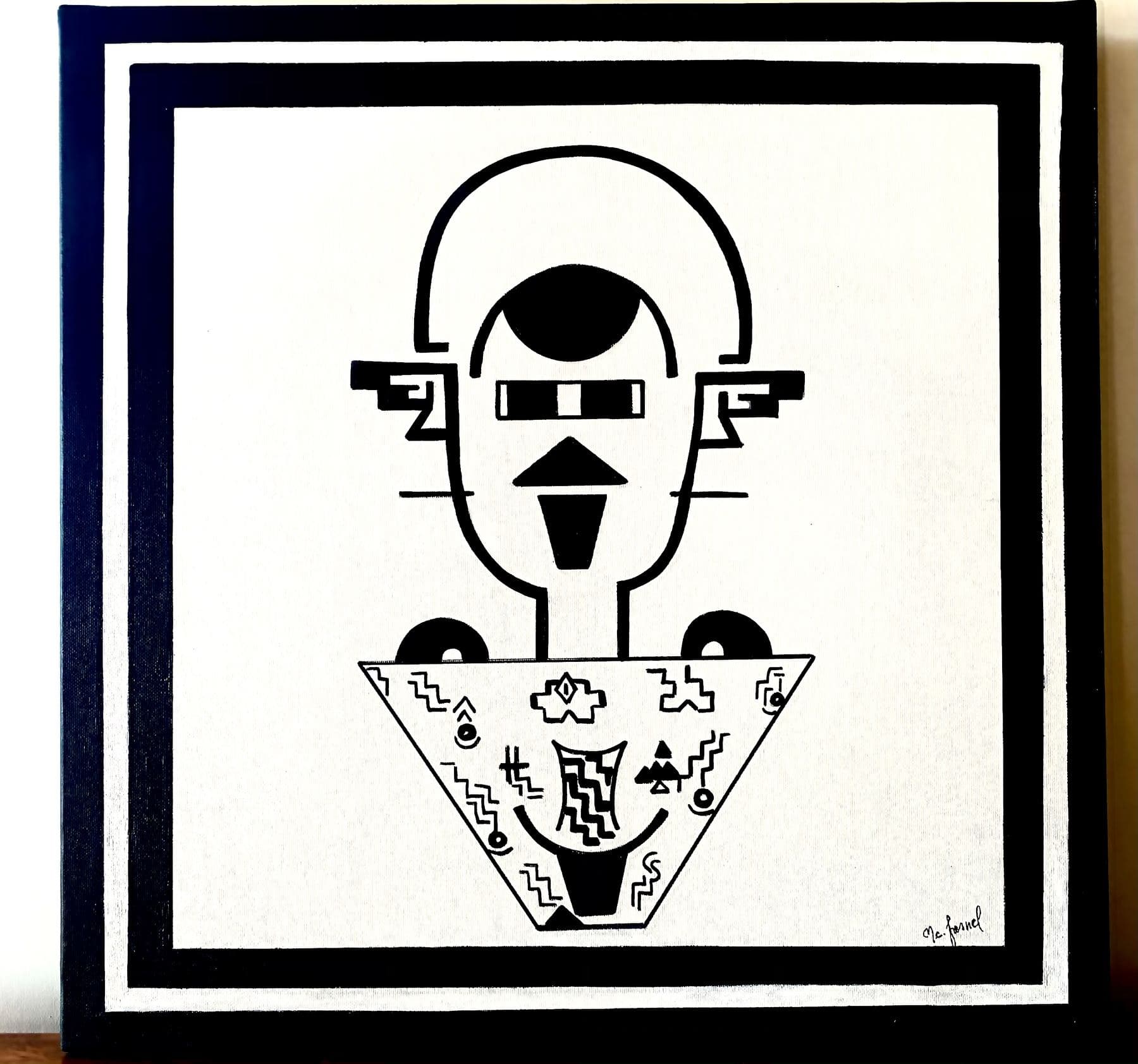
Constructive universalism, Madí, concretismo, neo-concretism: where does the geometric abstraction born in Uruguay, Argentina and Brazil actually come from? Trained between Buenos Aires and São Paulo, I trace a history that still runs through my own painting.
In 1943, Uruguayan painter Joaquín Torres-García drew an upside-down map of South America, Cape Horn pointing skyward: América Invertida. The gesture was as political as it was aesthetic — a refusal to let the South go on passively receiving artistic lessons from the North. That same drive for emancipation gave rise, between the 1930s and the 1950s, to Latin American geometric abstraction: a language of clean forms, saturated colour and rigorous composition, invented in Montevideo, Buenos Aires, São Paulo and Rio de Janeiro. It's also the tradition I trained in myself, between Buenos Aires and São Paulo, before settling in the Tarn. Here is the history of a movement too often reduced, seen from Europe, to a mere local variant of constructivism or neoplasticism.
What is Latin American geometric abstraction?
The term covers a group of movements that emerged in South America between the mid-1930s and the late 1950s. Like European geometric abstraction — Kandinsky, Mondrian, the Bauhaus — they favour clean form and structured composition, but they part ways with it through far more vivid colour and an openly embraced sensory dimension. Rather than simply importing a European vocabulary, movements such as Uruguay's constructive universalism, Argentina's Madí and concrete art, and Brazil's concretismo and neo-concretism, each invented a grammar of their own — one able to absorb Russian constructivism's lessons alongside pre-Columbian motifs and tropical light.
Torres-García and constructive universalism: the Uruguayan root
After more than forty years in Europe, in close contact with Cubism and with Mondrian, Joaquín Torres-García returned to Montevideo in 1934 and founded the Taller Torres-García there in 1943. He developed a doctrine he called 'constructive universalism': a rigorous geometric grid, inherited from neoplasticism, but one he filled with signs — fish, anchors, clocks, pre-Columbian figures — rather than emptying of symbols the way Mondrian did. His 1943 sketch América Invertida sums up the whole programme in a single image: a geometry that organises the world from the South's point of view, not the North's.
Concretismo and neo-concretism in Brazil: colour as sensory experience
In Brazil, two generations answered each other. In 1952, in São Paulo, Waldemar Cordeiro's Grupo Ruptura championed a rigorous concretismo, close in its rationalism to European constructivism. Two years later, in Rio de Janeiro, Ivan Serpa's Grupo Frente — whose members included Lygia Clark, Hélio Oiticica and Lygia Pape — took a more sensory direction. In 1959, the Neo-Concrete Manifesto, written by poet Ferreira Gullar, openly broke with São Paulo's cold rationalism: geometry, it argued, should be lived through the body and the senses, not merely calculated. That tension between geometric rigour and sensory, colourful experience still defines Latin American geometric abstraction today.
The Madí movement in Argentina: when form escapes the frame
In Buenos Aires, a year after the founding of the Asociación Arte Concreto-Invención, Carmelo Arden Quin, Gyula Kosice and Rhod Rothfuss launched the Madí movement in 1946. Its most radical signature was the marco recortado, or cut frame, which abandoned the canvas's classic rectangle to follow the irregular outline of the composition instead. Geometry was no longer just something painted — it reshaped the object itself, a freedom from the support that remains one of Latin American abstraction's most singular contributions to 20th-century art history.
Five traits that set Latin American abstraction apart from its European and New York cousins
- —Saturated, joyful colour, in contrast to European neoplasticism's deliberately restrained palette
- —Roots in local avant-gardes — Montevideo, Buenos Aires, São Paulo, Rio de Janeiro — rather than a straight import from the Bauhaus
- —A sensory, sometimes participatory dimension with neo-concretism, far from the cold rationalism of São Paulo concretismo or Russian constructivism
- —A challenge to the frame and support itself, through the Madí movement's marco recortado
- —An open dialogue with pre-Columbian motifs and South American cultural identity, especially visible in Torres-García
Geometry never needed to be cold to be rigorous — colour can structure a canvas just as firmly as a line.
My own inheritance: from Buenos Aires and São Paulo to my studio in the Tarn
Trained in painting, ceramics and pottery between Buenos Aires and São Paulo during the 1980s and 1990s, I grew up in direct contact with this concrete and neo-concrete tradition, long before I later found it again in art-history books. When I exhibited at the Halle aux Grains in Lavaur in 2022, my work was in fact presented as carrying an acknowledged Brazilian inspiration — a thread I've never cut. My own geometric abstraction, often built up with a palette knife for relief and texture, inherits that double lesson: the rigour of Torres-García's grid and sign, and the sensory colour vibration of Brazilian neo-concretism. You can see this tension between structure and colour at work in the Full Collection, and follow which exhibitions across France, Spain and Andorra have shown these canvases on the News page.
Tags
Frequently Asked Questions
What is Latin American geometric abstraction?+
It's a group of art movements that emerged in Uruguay, Argentina and Brazil between the 1930s and 1950s — constructive universalism, concrete art, the Madí movement, concretismo and neo-concretism — sharing a taste for geometric form while combining it with vivid colour and a sensory dimension distinctive to the continent.
What's the difference between Brazilian concretismo and neo-concretism?+
Concretismo, born in São Paulo with the Grupo Ruptura in 1952, favours a rational geometry close to European constructivism. Neo-concretism, formulated in Rio de Janeiro in 1959 by artists such as Lygia Clark and Hélio Oiticica, broke with that coldness to assert a sensory, bodily experience of form and colour.
Who was Joaquín Torres-García and why does he matter?+
A Uruguayan painter trained in Europe, Torres-García returned to Montevideo in 1934 and founded the Taller Torres-García in 1943, where he developed constructive universalism: a rigorous geometry incorporating pre-Columbian symbols. His sketch América Invertida, showing South America upside down, became a symbol of the continent's artistic emancipation.
What was the Madí movement?+
Founded in Buenos Aires in 1946 by Carmelo Arden Quin, Gyula Kosice and Rhod Rothfuss, the Madí movement pushed geometric abstraction as far as cutting the frame itself — the marco recortado — so it would follow the irregular shapes of the composition.
How does this tradition shape your painting today?+
Trained between Buenos Aires and São Paulo, I inherited this double tradition directly: the geometric rigour and love of sign from Torres-García, and the sensory colour vibration of Brazilian neo-concretism. You can recognise it in my palette-knife canvases, visible in the Full Collection.
Discover the works
Browse the full collection of original abstract paintings by M. C. Lamamie de Clairac.
View the Collection →