The Journal
How to Set Up a Home Painting Studio: Light, Table and Storage
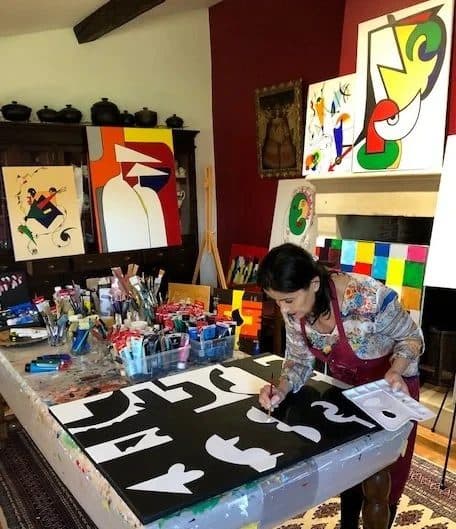
You do not need a large room to paint seriously. Light, work surface, floor, drying space and storage: practical essentials from a painter who works every day in her studio in the Tarn.
To set up a painting studio at home, sort out four things before buying anything: steady light for judging colour, a work surface at a comfortable height, a floor and walls that can get messy, and a place where canvases can dry without being moved. A whole room is not essential. A well-chosen corner, organised around the gesture of painting and the time paint needs to dry, lets you paint more often — and regular practice, far more than square metres, is what moves a body of work forward.
Choosing the spot: light before space
What matters most is not the size of the room but the quality of its light. Indirect daylight, without sun falling straight onto the canvas, shows colours as they are. In the northern hemisphere, a north- or east-facing window gives steadier light through the day. Direct sun causes glare on wet acrylic and dries paint too quickly on the palette. If your only window faces south, a white sheer curtain is often enough to diffuse it.
Think about water too. Acrylic cleans up with water, and walking through the house with loaded brushes soon becomes a reason not to paint. A studio near a tap, or simply equipped with a bucket and a water container, is much easier to tidy at the end of each session.
Add artificial light you can trust
Even with a good window, daylight changes with the hour and the season. For evening or winter painting, choose daylight LED bulbs around 5000 K with a high colour rendering index (CRI 90 or above, shown on the packaging). Avoid mixing warm and cool sources in the same room: a red will not look the same under each. Two light sources on either side of the work surface reduce the shadow your own hand casts on the canvas.
- —A diffuse main light, ceiling-mounted or free-standing, for the whole room
- —An adjustable lamp for detail, angled so it does not dazzle
- —Matching bulbs with the same colour temperature and CRI
- —A final check of colours in daylight before calling a painting finished
Table or easel: painting flat or upright
An easel is not compulsory. In the cover photograph I am painting flat, on a large protected table, a black-and-white geometric canvas. Working flat suits crisp areas of flat colour, marker lines and fluid paint that would run on a vertical support. An easel, by contrast, lets you step back and see the composition as it will hang. Many painters alternate: building the image on the table, then standing the canvas up to judge its balance.
If you keep only one piece of furniture, make it a sturdy table large enough for canvas and palette side by side, at a height that does not force you to hunch over. A top covered with heavy plastic sheeting or oilcloth wipes clean in seconds. The Journal has separate guides to the painting surface itself — canvas, wood or paper — and to materials for beginners; the studio is there to make all of that easy to use.
Protect, ventilate, store
Acrylic is a water-based paint and easier to use at home than solvent-based techniques. Once dry, though, it stains permanently. Protect the floor with a heavy drop cloth or a washable rug, keep rags within reach and wear an apron. Air the room regularly, and more so when varnishing or using sprays, following the manufacturer’s instructions on each product.
- —A wall or shelf reserved for drying, where fresh canvases do not touch
- —Finished paintings stored upright, protected from dust and direct sun
- —Jars or pots for each family of tools: brushes, palette knives, markers
- —A clean zone for paperwork, artwork photos and certificates
- —Products kept out of reach of children and pets
A studio does not need to be large; it needs to let you pick up the work again without setting everything up from scratch.
Inside my studio in the Tarn
My studio is in the Tarn, near Toulouse, and it remains first and foremost a place of work. The pots of markers and brushes sit in plain view on the table because they are used every day: in Viracocha, a 50 × 50 cm canvas, acrylic and marker work together, and that kind of line is most precise when painted flat. A large palette-knife canvas such as Équilibre, at 120 × 100 cm, needs a solid wall or support instead, and room to step back and judge the whole.
To see the works made in this space, browse the Collection, or check the News page for upcoming exhibitions. Studio visits are possible by appointment through the Contact page. And if you are preparing your own painting corner, my daily studio routine shows how this kind of set-up translates, in practice, into hours of work.
Tags
Frequently Asked Questions
Which room is best for a home painting studio?+
A room or corner with indirect daylight, ideally a north- or east-facing window, a floor you can protect and water nearby. Floor area matters less than light and a place where canvases can dry undisturbed.
What lighting should I use for painting at night?+
Daylight LED bulbs around 5000 K with a colour rendering index of 90 or higher. Use matching bulbs and two sources on either side of the work surface to avoid shadows.
Do I need an easel to paint?+
No. You can paint flat on a sturdy table, which suits flat colour, marker work and fluid paint. An easel mainly helps you step back; many painters use both.
Can I paint with acrylics in an apartment?+
Yes. Acrylic thins and cleans up with water, which makes it well suited to a home. Protect the floor, ventilate regularly and follow the manufacturer’s instructions, especially for varnishes and sprays.
How much space does a painting studio need?+
There is no single minimum: you need room for canvas and palette side by side, a few steps to judge the composition from a distance, and a drying area. Large formats require more distance and a solid wall.
Discover the works
Browse the full collection of original abstract paintings by M. C. Lamamie de Clairac.
View the Collection →