The Journal
Acrylic Pouring: Technique, Materials and Steps for Painting with Fluid Art
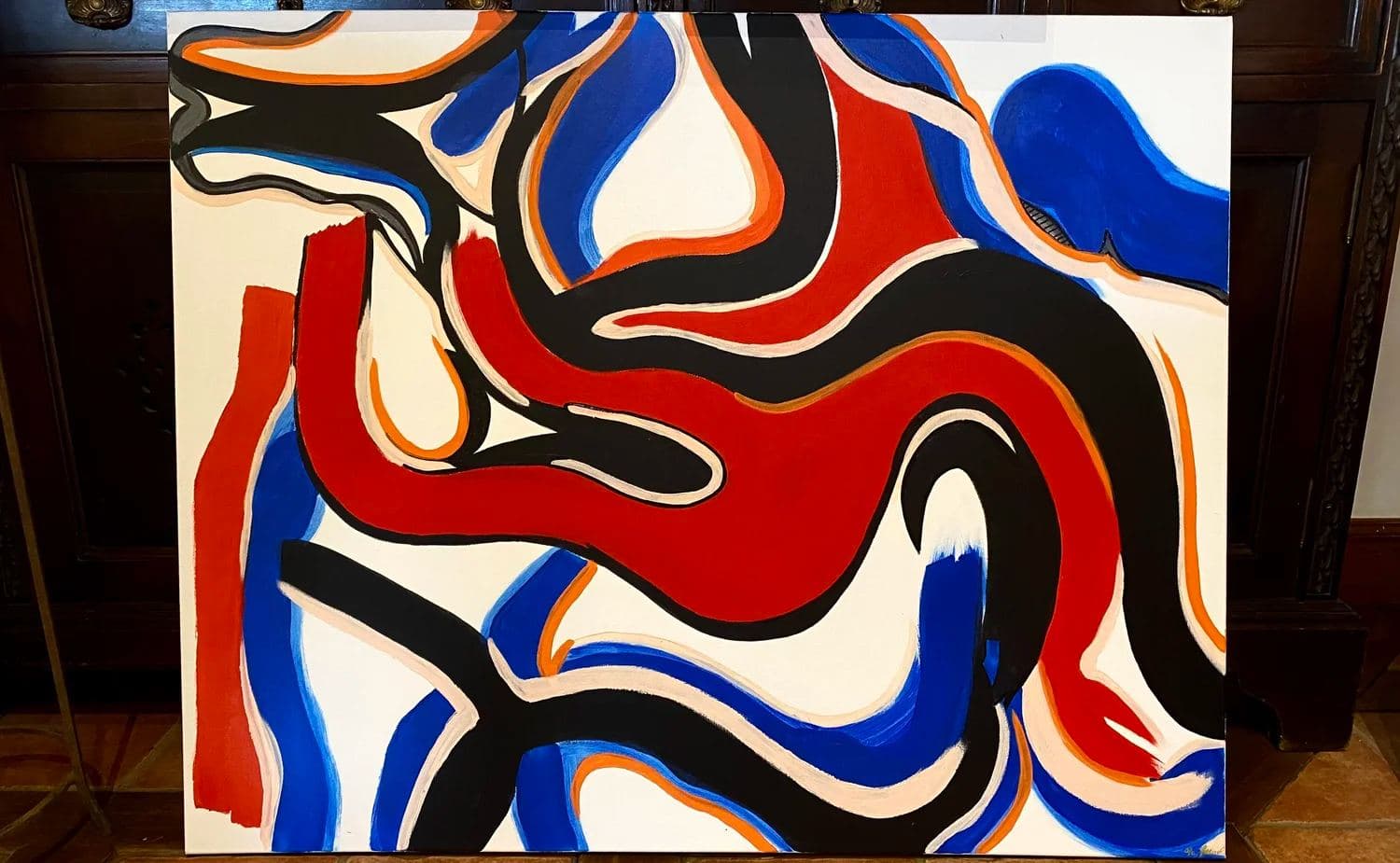
Paint that finds its own way across the canvas, with no brush or knife involved: acrylic pouring has become one of the most shared abstract techniques online. What it is, what materials it takes and how it's done, seen from the studio of a geometric painter who would rather tame chance than surrender to it.
A canvas laid flat, a mix of colours poured in a single motion, and the paint finding its own way into cells and marbling: that's the promise of pouring, one of the most filmed and shared abstract techniques online for over a decade now. Unlike brush or palette-knife work, where every mark is decided by hand, pouring leaves a large role to gravity and to the chemistry of the materials themselves. As a geometric painter who builds every composition with a palette knife, I want to look at this technique from the outside: what it is, how it works, and why it interests me even though I've never practised it myself.
What is acrylic pouring?
Pouring — or fluid art — involves thinning acrylic paint with water and a specific pouring medium until it reaches a honey-like consistency, then pouring it directly onto a canvas or rigid support without any brushwork. Once poured, the paint spreads and blends under its own weight and the density differences between colours, producing marbling, cells and gradients that no hand could recreate identically twice. It's a form of abstraction where the artist sets up the conditions for chance rather than dictating the final result.
A technique rooted in gesture, popularised by social media
The idea of letting the material itself compose part of the work isn't new: it owes a great deal to the liberated gesture of New York Abstract Expressionism in the 1940s and 50s, when Jackson Pollock let paint fall directly onto a canvas laid on the floor rather than applying it with a brush — a movement I cover in more detail in an earlier Journal article. Pouring as it's practised today, with its stacked cups and cell effects, is a much more recent invention: it was in the 2010s, driven by video tutorials and social media, that the technique spread widely among hobbyist painters worldwide, becoming one of the most popular entry points into abstract art.
The materials you need to get started
- —Fluid acrylic paint, or regular acrylic paint thinned with water
- —A pouring medium, which thins the paint without weakening its colour once dry
- —Cups to prepare each colour, plus a larger cup to layer them before pouring
- —A perfectly level support — stretched canvas, wood panel or ceramic tile — raised on risers so excess paint can drip away
- —A kitchen torch or heat gun, to pop air bubbles and reveal cells
- —Silicone oil, in a very small amount, if you're after well-defined cells
- —A drop cloth and gloves: pouring always spreads further than you'd expect
The technique step by step: ratio, pouring and cells
The most common starting ratio is roughly one part acrylic paint to two or three parts pouring medium, adjusted until the mixture flows continuously without being too thick or too runny — the ribbon test, where a trail of paint should settle back into the surface without sinking straight away, remains the most reliable guide. In the so-called "dirty pour" method, several colours are poured one after another into the same cup before being tipped out onto the canvas in a single motion; it's this layering that, once the canvas is tilted in several directions to spread the paint, produces the marbling. Briefly passing the torch a few centimetres above the surface then lifts trapped air bubbles and reveals cells, the concentric circles so characteristic of pouring. Drying comes last, and needs several days flat and away from dust before the piece can be moved at all — and, as with any acrylic canvas, several weeks before varnishing can even be considered, a point I cover in the Journal article on caring for and varnishing an acrylic painting.
I'd rather tame chance than surrender to it completely — that's the whole difference between letting a colour run and building a geometry.
Pouring, seen from my studio: why I stay loyal to geometry and the palette knife
I've never practised pouring myself: my work is built the opposite way, canvas after canvas, from lines decided in advance and a material I shape with a palette knife rather than let run. But I understand its popularity perfectly — it belongs to the same family of gestures that trust the material more than the drawing, a family stretching from American Abstract Expressionism to these contemporary practices shared online today. Since returning to painting in 2020, I've shown my geometric abstraction across France, Spain and Andorra — a journey you can follow on the News page, and one whose canvases, built with a palette knife rather than poured, are gathered in the Collection.
Tags
Frequently Asked Questions
Is acrylic pouring easy for a beginner?+
The pouring motion itself is easy to repeat, but getting a controlled result takes several attempts: the right dilution ratio, how far you tilt the canvas and how much silicone oil to add are mostly learned through practice and watching your own failures.
What's the difference between pouring and fluid art?+
Both terms describe the same family of techniques; "fluid art" is simply the broader umbrella term, covering pouring as well as other variants such as the swipe or the dirty pour.
Do you need to varnish a pouring painting?+
Yes, like any acrylic painting: varnish protects the surface and evens out the sheen, but it should only go on once the canvas is completely dry all the way through, which can take several weeks for a thick pouring layer.
Is pouring recognised as a contemporary art technique in its own right?+
It's still mostly practised as a hobbyist, decorative technique, though some contemporary artists fold it into more deliberate bodies of work — the line between craft technique and artistic practice comes down to intent and control of the gesture, not the tool itself.
Can you pour onto any support?+
No: the support needs to be rigid or tightly stretched and able to withstand the prolonged moisture of the water-medium-paint mixture — a loosely stretched canvas or paper that's too thin risks warping before drying is even finished.
Discover the works
Browse the full collection of original abstract paintings by M. C. Lamamie de Clairac.
View the Collection →