The Journal
Geometric Abstraction vs Minimalism: What's the Real Difference?
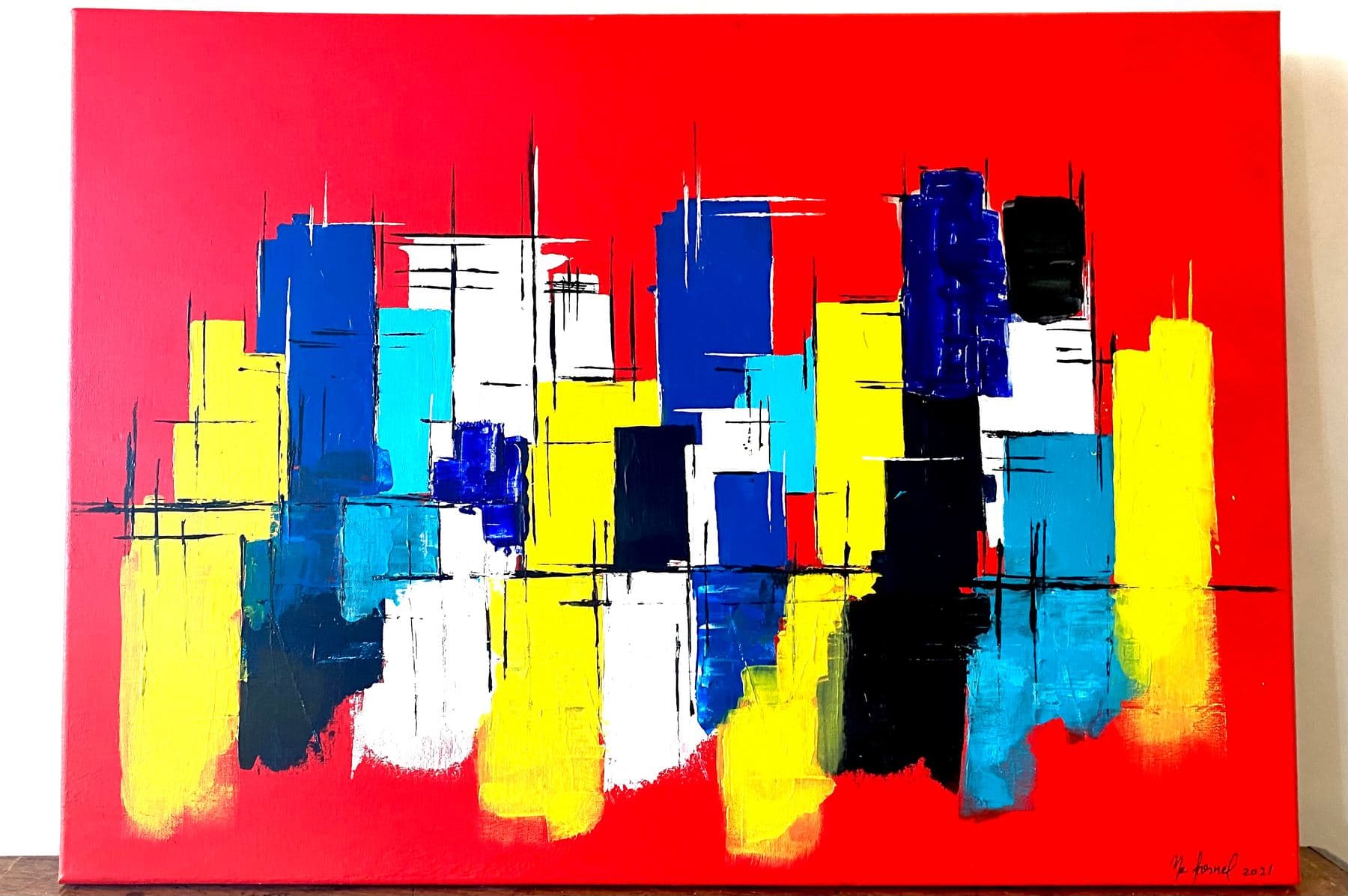
Clean lines, simple shapes, an embrace of geometry: geometric abstraction and minimalism share a visual vocabulary close enough to be routinely mixed up. Yet one builds with colour and material, the other strips everything back to the bare object. A geometric painter trained in Latin America explains what actually separates these two aesthetics — and why her own work sits firmly on the side of colour.
A canvas built from clean shapes and straight lines: is that geometric abstraction, or is it minimalism? The confusion is common, and understandable — both aesthetics share a taste for rigour and a rejection of figurative representation. Yet they remain two distinct stories, born decades apart and driven by almost opposite intentions. In this new Journal article, I untangle two styles that get confused far too often, and explain why my own work, geometric to its core, has nothing minimalist about it.
Two histories, two continents, two decades apart
Geometric abstraction is born in Europe at the very start of the 20th century: Wassily Kandinsky paints his first abstract watercolour in 1910, before Kazimir Malevich with Suprematism, and then Piet Mondrian and the De Stijl movement, lay the groundwork for a geometry built with a ruler and a set square — I trace that history in more depth in the article on geometric versus lyrical abstraction. Minimalism, by contrast, emerges nearly half a century later, in New York, in the early 1960s — not as an extension of that European geometry, but as a reaction against the Abstract Expressionism that dominated the American scene at the time. Where Pollock or de Kooning let gesture take over the canvas, the minimalists wanted, if anything, to purge it entirely.
Minimalism: reducing the work to the essential, down to the object
The term takes hold with 'Specific Objects', the essay published by sculptor Donald Judd in 1965, which champions simple forms — often industrially fabricated rather than handmade — stripped of any metaphor or hidden subject. Sol LeWitt develops modular structures and grids conceived as systems rather than compositions; Frank Stella paints fan- and cross-shaped canvases, summing up his approach in a line that became famous: 'what you see is what you see'. Agnes Martin builds near-monochrome grids in pencil and thinned paint, while Dan Flavin composes directly with off-the-shelf fluorescent tubes. What unites them all: a reduced palette, a smooth, impersonal surface, and a flat refusal of any emotion suggested by the painter's hand.
Geometric abstraction, by contrast, builds with colour and material
Geometric abstraction doesn't empty the canvas — it organises it. Clean shapes and controlled lines, yes, but always in service of a composition rich in colour, contrast and, very often, texture. This is especially true of the Latin American tradition I come from — the Concrete and Neo-Concrete movements born in Brazil and Argentina in the 1950s, which I cover in the article on Latin American geometric abstraction — which set a vibrant, sensory, fully colour-embracing geometry against North American coolness. The painter's hand, the texture of acrylic, the thickness built up with a palette knife: none of that has a place in a minimalist vocabulary.
Five cues for telling the two styles apart
- —Colour — rich, contrasted and embraced in geometric abstraction; reduced, often monochrome or metallic, in minimalism
- —Material — thickness, texture and the trace of the hand (brush, knife) in geometric work; smooth, impersonal surfaces, sometimes industrially fabricated, in minimalism
- —Composition — organises a rhythm, a tension, an emotion in geometric work; is limited to the object itself, with no metaphor or subtext, in minimalism
- —The artist's hand — visible and embraced in geometric work; erased, even delegated to a fabricator, in minimalism
- —Relationship to space — the piece remains a canvas on the wall in geometric work; minimalist pieces often spill into sculpture or installation
I build my geometry with colour and material, never to empty the canvas — quite the opposite, to fill it.
My geometry: dense, colourful, never minimalist
Trained in painting between Buenos Aires and São Paulo before settling in the Tarn, I inherited a geometry that favours chromatic density over stripped-back reduction. A painting like Ville Cubique, on this article's cover, makes the point well: crisp geometric shapes, but crossed with vivid colour and layering that has nothing of a neutral industrial object about it. It's the exact opposite of the minimalist approach — and it's precisely that embraced tension between geometric rigour and chromatic exuberance that I've been exploring since returning to painting in 2020. You can compare this approach to other artists' work by browsing more than forty pieces in the Full Collection, or come see it in person at an upcoming exhibition in France, Spain or Andorra, announced on the News page.
Tags
Frequently Asked Questions
Is minimalism a form of geometric abstraction?+
The two share a vocabulary of simple shapes and clean lines, but they're historically distinct movements. Geometric abstraction emerges in Europe from 1910 onward around Kandinsky, Malevich and Mondrian; minimalism appears nearly fifty years later in New York, as a reaction against Abstract Expressionism, with an almost opposite intent: reduction rather than composition.
Who are minimalism's founding artists?+
The movement takes shape mainly in 1960s New York with Donald Judd, whose essay 'Specific Objects' (1965) lays its theoretical groundwork, alongside Sol LeWitt, Frank Stella, Agnes Martin and Dan Flavin, each exploring the reduction of form, colour and gesture in their own way.
Why isn't Latin American geometric abstraction minimalist?+
Because it shares the same taste for geometry but points it in the opposite direction: the Brazilian and Argentine Concrete and Neo-Concrete movements, whose lineage I claim, favour vibrant colour and a fully embraced sensory dimension, while minimalism sets out precisely to erase all emotional and chromatic charge.
How can you recognise a minimalist painting at a glance?+
Look for a reduced, often near-monochrome palette, smooth surfaces with no visible trace of the painter's hand, a serial or modular composition, and the absence of any metaphor — the work refers only to itself, telling no story and suggesting no particular emotion.
Discover the works
Browse the full collection of original abstract paintings by M. C. Lamamie de Clairac.
View the Collection →