The Journal
Mondrian and Neoplasticism: The History of the De Stijl Movement and Its Grid
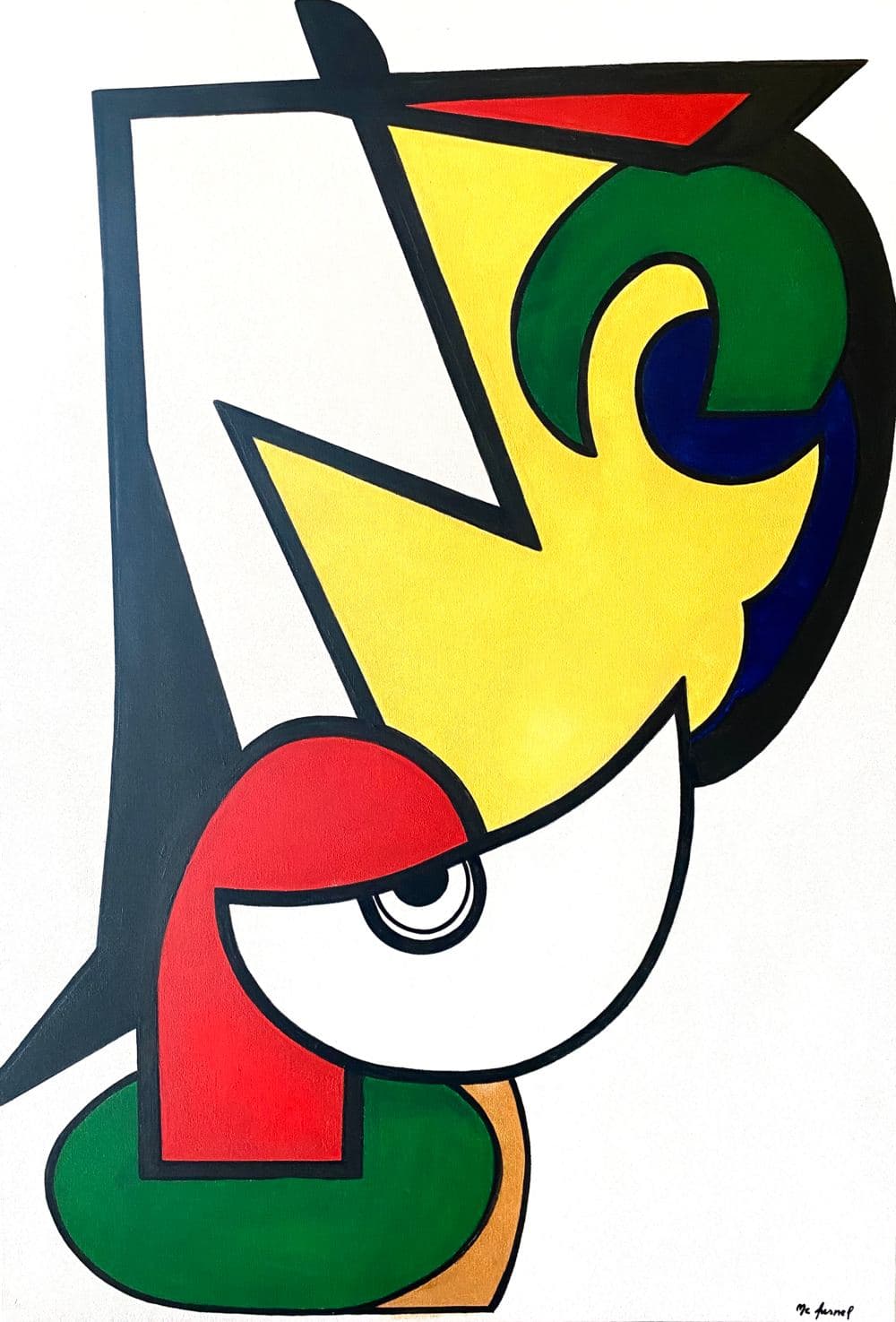
Three colours, two non-colours, only straight lines: few artists have ever pared their vocabulary down this far to say this much. Here's the history of Piet Mondrian's Neoplasticism, the De Stijl journal that carried it, and what a geometry this strict owes — or doesn't — to my own.
One black line running horizontal, another vertical, a flat block of red, yellow or blue sitting inside the cells they carve out: few works of art are as instantly recognisable, worldwide, as a Piet Mondrian composition — recognisable enough to have ended up on dresses, record sleeves and building façades without anyone needing to spell out where the reference comes from. Yet that grid wasn't born from a taste for restraint: it's the endpoint of a complete theory, Neoplasticism, carried by an entire Dutch movement, De Stijl. Here's its history, its rules, and what a geometry this radical owes, or doesn't, to my own.
Neoplasticism was a theory before it was a style
The word Neoplasticism — Nieuwe Beelding in Dutch, literally 'new plastic art' — is a term Mondrian coined himself, worked out across a series of texts published between 1917 and 1920 and later gathered into his essay Neo-Plasticism. It doesn't describe a simple aesthetic preference for straight lines: it sets out a theory of art as the expression of a universal balance. For Mondrian, the curved line and the modulated colour stay tied to the particular, to anecdote, to the individual subject, while the straight line and pure, flatly applied colour reach a harmony beyond the individual. Painting as a Neoplasticist, for him, wasn't one compositional choice among others — it was an almost moral discipline, applied with a rigour that barely wavers between 1920 and his death in 1944.
De Stijl: a journal founded in Leiden in 1917
Mondrian's Neoplasticism didn't develop in isolation: it found its platform in De Stijl ('the style'), a journal founded in the Netherlands in 1917 by painter and theorist Theo van Doesburg, who remained its tireless driving force until his death. Van Doesburg brought together Mondrian, but also architects and designers — Gerrit Rietveld, who designed the Red and Blue Chair in 1917 and the Rietveld Schröder House in Utrecht in 1924, and J. J. P. Oud among them — around a shared ambition: to forge, in the wake of the trauma of the First World War, a universal visual language, free of national particularism and superfluous decoration, applicable equally to a painting, a chair or a façade.
The strict rules of Mondrian's Neoplasticism
What stands out about Mondrian, more than any other geometric artist, is how few elements he allowed himself — and how consistently he stuck to them:
- —Only straight lines, horizontal or vertical, never a diagonal or a curve
- —A palette limited to the three primary colours — red, yellow, blue — and the three non-colours — white, black, grey
- —Perfectly flat colour planes, with no gradient, no shading, no visible surface texture
- —Asymmetric rather than symmetric balance, with no cell exactly echoing another
- —A refusal of any figurative reference, however distant, even in the titles — Mondrian numbered his Compositions rather than naming them
It's precisely on this bedrock of rules that the movement fractured. In 1924, Theo van Doesburg introduced the diagonal into his own work, under the name Elementarism, convinced it carried a tension and dynamism the horizontal-vertical grid couldn't reach. Mondrian, who saw the diagonal as a flat betrayal of the movement's founding principle, broke with the De Stijl group in 1925 and carried on alone, in his Paris studio, applying his own rules to the very end. The journal itself didn't long outlive its founder: the 1932 issue, published after van Doesburg's death in 1931, was devoted entirely to him, and effectively marked the movement's end.
One black line and three colours can be enough to hold up an entire world — but it isn't the world I paint in: mine needs relief, material, and a colour that spills a little past the edge it's given.
My geometry and Mondrian's: a shared vocabulary, an opposite method
I share with Mondrian and De Stijl the same taste for geometric structure and deliberate composition — but my practice departs from his on almost every point that makes his work so radical. Where he limits himself to three flat primary colours, my palette, shaped by my training between Buenos Aires and São Paulo, draws on the full vibrant, exotic range of Latin American abstraction, as I cover in the article I devote to that tradition. Where he refuses any visible material, I often build my canvases with a palette knife, in thick layers the light can carve into — the opposite of the perfectly smooth plane he was after. His grid interests me as a grammar — the idea that a straight line structures a space better than a hesitant contour — but I share neither his chromatic asceticism nor his refusal of texture. You can see this tension between geometric rigour and living material in the Full Collection, and check the calendar of my upcoming exhibitions across France, Spain and Andorra on the News page.
Why Mondrian's grid is everywhere, far beyond painting
Few twentieth-century works have travelled as far outside the frame of the painting. In 1965, couturier Yves Saint Laurent presented his so-called 'Mondrian' dress collection, straight shift dresses lifting the grid motif and its colour blocks wholesale — a gesture that permanently lodged the idea that even the most radical geometric painting can be worn on the street. Since then, Neoplasticism's vocabulary has run through graphic design, typography and interior decor, often reduced to its surface alone — the grid, the primary colours — stripped of the theory of universal balance that gave rise to it. Mondrian himself, though, was never quite locked into his own formula: arriving in New York in 1940, he painted Broadway Boogie Woogie (1942-43), where black gives way to rows of small colour squares, syncopated like the jazz and the New York avenues he was discovering — proof that even the strictest rule can still evolve, late in a life, on contact with a new world.
Tags
Frequently Asked Questions
What is Neoplasticism?+
Neoplasticism, or Nieuwe Beelding, is the art theory developed by Piet Mondrian from 1917 onward: a geometric abstraction reduced to horizontal and vertical lines, the three primary colours (red, yellow, blue) and the three non-colours (white, black, grey), applied in perfectly flat planes.
When was the De Stijl movement founded, and by whom?+
De Stijl is a journal and movement founded in the Netherlands in 1917 by painter and theorist Theo van Doesburg, who brought together Piet Mondrian along with architects and designers such as Gerrit Rietveld, aiming to create a universal visual language applicable to painting, architecture and design.
Why did Mondrian only use red, yellow, blue, white, black and grey?+
For Mondrian, only pure primary colours and non-colours escaped the particularism of a mixed or shaded tone and could reach the universal balance Neoplasticism aimed for — any intermediate shade, in his view, stayed too tied to individual anecdote.
What's the difference between the Bauhaus and De Stijl?+
The Bauhaus was an art, craft and architecture school founded in Germany in 1919, teaching geometric abstraction as one approach among several; De Stijl was a Dutch movement founded around the same time centred on a journal and a single, far stricter theory, Mondrian's Neoplasticism, limited to straight lines and the three primary colours. I cover the Bauhaus's history in another Journal article.
Does M. C. Lamamie de Clairac's work draw directly on Mondrian?+
Not directly: my geometry owes more to the Latin American concrete and neo-concrete tradition, with a far more vibrant palette and palette-knife material work that Mondrian, faithful to the smooth flat plane, ruled out for himself. I share his taste for the straight line and structured composition, without his chromatic asceticism.
Discover the works
Browse the full collection of original abstract paintings by M. C. Lamamie de Clairac.
View the Collection →