The Journal
Is Cubism Abstract Art? The Roots of Geometric Abstraction
Picasso, Braque and a question that keeps coming up: was Cubism already abstract? A look at the movement that cracked the door open for 20th-century geometric abstraction.
"Isn't Cubism already abstract art?" People ask me this often, standing in front of some of my paintings with their interlocking geometric planes — convinced that Picasso painted the first abstract work with his faces broken into facets. The truth is more nuanced, and far more interesting: Cubism never gave up on representing the world. But it's exactly what cracked open the door that geometric abstraction slipped through only a few years later. Here's what the most radical movement of the early 20th century owes to Cézanne — and what the abstraction that followed owes to it in turn.
Is Cubism abstract art? A distinction worth making
Not strictly, no. However fragmented, a Cubist painting always keeps a recognisable subject: a face, a guitar, a bottle, a fruit bowl. Picasso and Braque don't erase the motif — they break it into a multitude of geometric facets seen from several angles at once, then reassemble it on a flat surface. It's this break with classical perspective — a single fixed viewpoint inherited from the Renaissance — that unsettles the eye and fuels the confusion with abstraction. But as long as a subject stays identifiable, however fragmented, we're still in figurative territory. True abstraction would give up that subject entirely only a few years later.
From Cézanne to Picasso and Braque: the birth of Cubism (1907-1914)
The groundwork for Cubism lies with Paul Cézanne, who wrote to his friend the painter Émile Bernard in 1904 that nature should be "treated through the cylinder, the sphere and the cone" — an invitation to see the geometric structure beneath the world's forms. Pablo Picasso seized on the idea with force in 1907 in Les Demoiselles d'Avignon, where faces fracture under the influence of the Iberian and African masks he was discovering at the time. From 1908 onward he worked almost daily alongside Georges Braque, so closely that the two painters later said they could no longer tell their own canvases apart from each other's. Even the movement's name comes from a jab: critic Louis Vauxcelles, echoing a remark attributed to Matisse about Braque's landscapes at L'Estaque, described paintings "made of little cubes" — a mocking label that stuck.
Analytic Cubism vs Synthetic Cubism: what changes
The movement moves through two quite distinct phases between 1907 and 1914, and mixing them up is the most common mistake:
- —Analytic Cubism (1909-1912): an almost monochrome palette — ochres, greys, browns — the subject dissected into a multitude of small facets seen from several angles at once, to the point of near illegibility
- —Synthetic Cubism (1912-1914): colour returns, along with larger, more legible shapes — the subject becomes recognisable again at a glance
- —The invention of papier collé: in 1912, Braque glued a piece of wood-grain paper onto his painting Fruit Dish and Glass — the first time an everyday material entered a Western painting as an element in its own right, rather than something depicted
- —Multiple viewpoints at once: the same object — a violin, a glass — is shown from the front and in profile on the same canvas, replacing the single perspective inherited from the Renaissance with several simultaneous views
The bridge to geometric abstraction: Delaunay, Mondrian, Malevich
It's this last idea — several viewpoints layered onto a single surface, colour and shape freed from faithfully describing the real — that becomes the springboard for early abstraction. As early as 1912, Robert Delaunay pushed Cubist fragmentation toward near-total abstraction with his discs of pure colour, a current his friend the poet Guillaume Apollinaire named "Orphism". Piet Mondrian went through a genuine Cubist period in Paris between 1911 and 1913 — his still lifes from those years, still close to Braque, already hint at the geometric grid he would theorise a few years later, back in the Netherlands. Kazimir Malevich followed a comparable path: after a phase now described as "Cubo-Futurist", he broke with the subject entirely in 1915 to found Suprematism around his Black Square on a White Ground. Without Cubism cracking that door open, these three routes toward pure abstraction would likely have taken a very different shape.
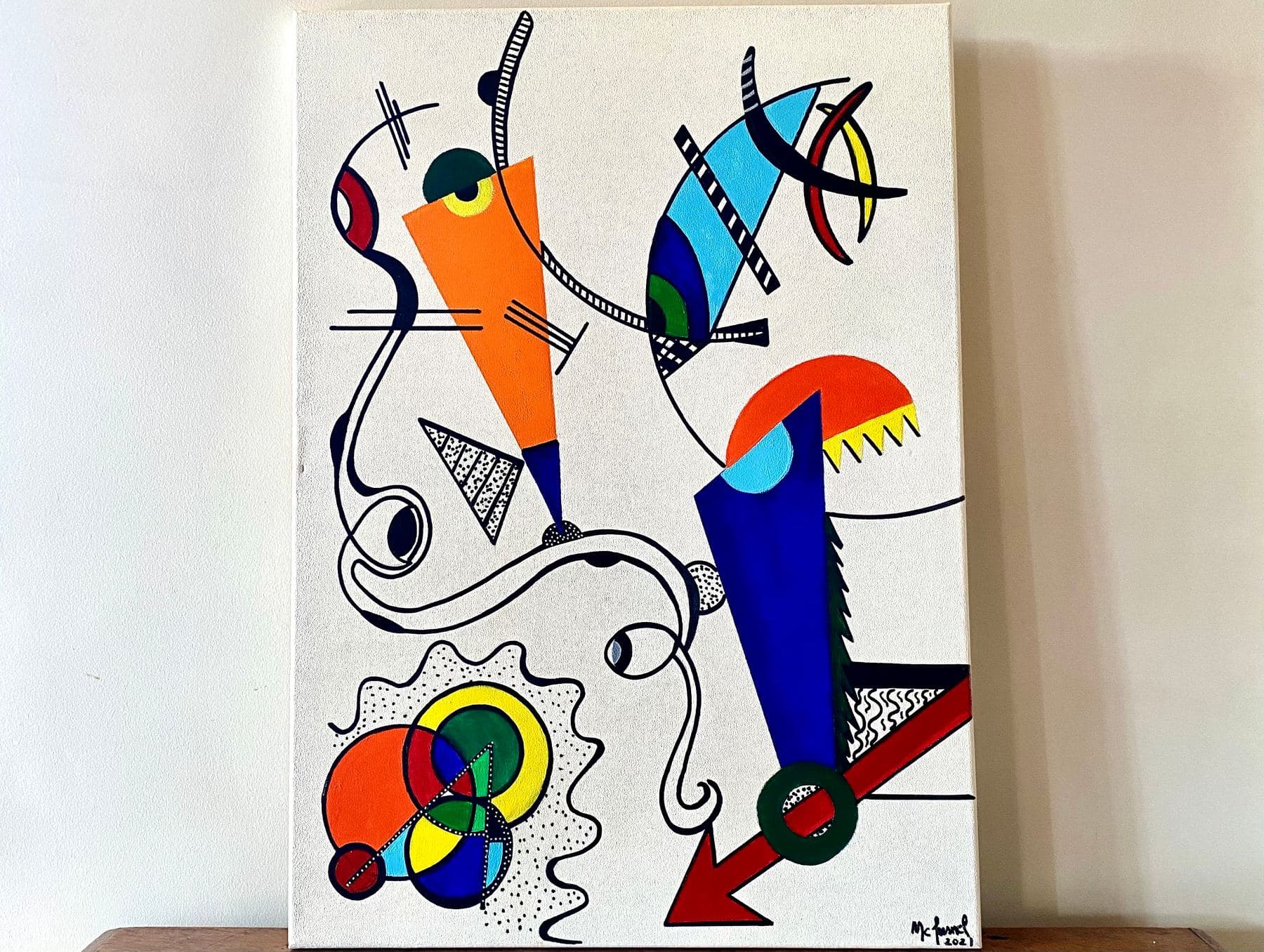
I never fragment a face the way Picasso or Braque did — my work sits in the fully abstract branch of this history. But the idea that a single canvas can hold several planes, several tensions, without ever settling into one fixed viewpoint — that's something I find, in my own way, in every one of my geometric compositions.
What my geometric abstraction owes — and does not owe — to Cubism
I wouldn't claim Cubism as my heritage in any strict sense: my paintings don't fragment any face or everyday object, and my own lineage, which I trace in the article on Latin American geometric abstraction, runs more through Kandinsky and then the Concrete and Neo-Concrete movements born in Buenos Aires and São Paulo, where I trained. But Picasso and Braque deserve credit for being the first to prove that a single canvas could organise several planes of colour and shape without answering to one fixed perspective — a principle that still runs through my most geometric compositions, such as Ijometry or Polarité Opposée. You can find these paintings, and many more, in the Full Collection, and meet me in person at my upcoming exhibitions across France, Spain and Andorra, listed on the News page.
Tags
Frequently Asked Questions
Is Cubism abstract or figurative art?+
Cubism remains a figurative art form: however fragmented into multiple geometric facets, the subject — a face, an object, a still life — stays identifiable. True abstraction would give up that subject entirely only a few years later, with Kandinsky and then Malevich and Mondrian.
What is the difference between Analytic and Synthetic Cubism?+
Analytic Cubism (1909-1912) fragments the subject into a multitude of facets within an almost monochrome palette, to the point of near illegibility. Synthetic Cubism (1912-1914) returns to larger, more colourful, more legible shapes, and introduces papier collé.
Who invented Cubism, Picasso or Braque?+
Neither one alone: the movement grew out of an almost daily collaboration between Pablo Picasso and Georges Braque between 1908 and 1914, so close that the two painters later said they could no longer tell their own canvases apart. The name "Cubism" itself comes from a mocking remark by critic Louis Vauxcelles.
Did Cubism really influence the birth of geometric abstraction?+
Yes, directly: Robert Delaunay pushed Cubist fragmentation toward pure abstraction as early as 1912 with Orphism, while Piet Mondrian and Kazimir Malevich both went through a Cubist period before breaking with the subject entirely, through Neoplasticism and Suprematism respectively.
Does contemporary geometric abstraction still carry traces of Cubism?+
In its compositional logic, yes: organising several planes of colour and shape on a single canvas without one fixed perspective is still a reflex inherited from Cubism, even in a fully geometric abstraction like mine, which no longer fragments any recognisable subject.
Discover the works
Browse the full collection of original abstract paintings by M. C. Lamamie de Clairac.
View the Collection →