The Journal
Malevich and Suprematism: the Story of the Black Square
In 1915, in Petrograd, an almost entirely black canvas was hung in the spot reserved for religious icons. That gesture founded Kazimir Malevich's Suprematism — one of the most radical currents in the history of abstraction, one that every geometric abstraction since owes something to, in its own way.
An almost entirely black canvas, hung in 1915 high in the corner of an exhibition room in Petrograd — the exact spot where a Russian household would traditionally place its icons. That gesture, as simple as it was provocative, launched one of the most radical movements in the history of art: Kazimir Malevich's Suprematism. More than a century on, the Black Square still divides opinion — pure nothingness to some, the logical endpoint of an entire history of abstraction to others. Here's the story of a movement I've referenced in passing across several of my own articles on geometric abstraction, without ever giving it the space it deserves.
What is Suprematism?
Suprematism is a painting movement founded by Kazimir Malevich in Russia around 1915, pushing geometric abstraction to its breaking point: no reference to the visible world, no perspective, no horizon — only pure geometric shapes (square, circle, cross, rectangle), almost always flat colour, floating on a white ground treated as infinite space. The Russian word supremus means 'supreme': for Malevich, it stood for the absolute primacy of pure feeling over any description of reality, even an already abstracted one, as in the Cubism and Futurism he came from.
1915: the birth of the Black Square
Malevich moved through an Impressionist phase, then a Neo-Primitivist one, and finally a Cubo-Futurist period, before breaking with the subject entirely in 1915. He unveiled his first Suprematist canvases — including Black Square on White Ground — at the Last Futurist Exhibition of Paintings '0,10' in Petrograd that December, alongside a manifesto with an unambiguous title: From Cubism and Futurism to Suprematism: The New Realism in Painting. In photographs of the hang, the Black Square holds pride of place, high in the corner of the room — precisely where an Orthodox Russian family would have hung an icon. The message was unmistakable: this square wasn't decoration, but an object of contemplation meant to replace the old sacred with a new one.
A scientific footnote revived interest in the painting in 2015: an X-ray analysis by Moscow's Tretyakov Gallery revealed a handwritten inscription and an earlier Cubo-Futurist composition beneath the black paint layer — proof that even Malevich's most radical gesture wasn't born in a single stroke, but painted over an earlier idea.
The Suprematist vocabulary
- —Elementary geometric shapes — square, circle, cross, rectangle — never an organic curve or a decorative motif
- —A white ground treated as boundless space, with no horizon or gravity, where shapes appear to float freely
- —A palette limited at first to black, white and red, later opening onto other pure colours in later Suprematist compositions
- —A dynamic composition, with shapes slightly tilted or off-centre to suggest movement rather than fixed symmetry
- —The movement's endpoint in 1918 with White on White, an almost invisible square painted in white on a subtly different white ground
From Suprematism to Soviet silence
In the years following the October Revolution, Malevich taught in Vitebsk, where he founded the UNOVIS group with several of his students, among them El Lissitzky, who later carried this geometric vocabulary as far as the German Bauhaus. Suprematism set itself apart from the emerging Constructivism of Alexander Rodchenko and Vladimir Tatlin, which leaned toward art's social usefulness — architecture, design, propaganda — where Malevich defended a non-objective art, free of function or political message. That freedom didn't survive the Soviet regime for long: from the late 1920s, abstract art was judged incompatible with the Socialist Realism imposed under Stalin, and Malevich, under pressure, returned to a form of figuration in his final years. He died in Leningrad in 1935, largely forgotten, and the Black Square stayed locked away in Soviet museum storerooms for decades before being rediscovered by Western art history.
Malevich stripped colour away to reach the essential; I look for mine by multiplying it instead — two opposite roads toward the same freedom from subject.
What I keep from Suprematism
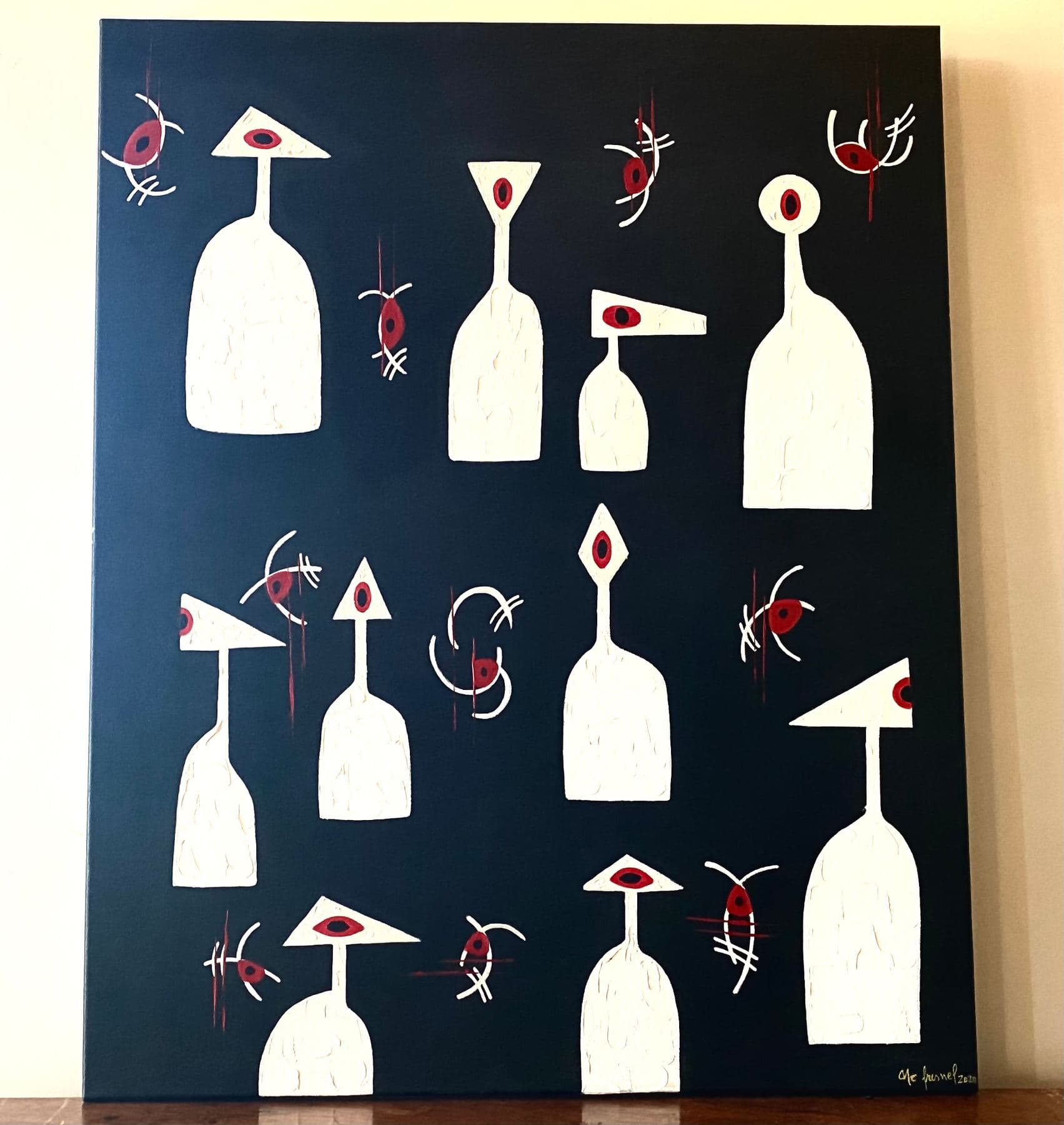
Suprematism isn't my abstraction: my painting stays built around colour, material and the relief of the palette knife, at the opposite pole from Malevich's radical reduction. But I owe it, like every geometric abstraction that followed, a founding lesson — that a simple shape, placed with intent on a canvas, can carry the full weight of a work on its own, without needing to represent anything else. It's a tension I recognise in my own geometric compositions, on view in the Full Collection, and one I've been able to share across my exhibitions in France, Spain and Andorra, whose full history you can find on the News page.
Tags
Frequently Asked Questions
What is Malevich's Black Square?+
Black Square on White Ground is a canvas painted by Kazimir Malevich in 1915, regarded as the founding work of Suprematism. First shown at the '0,10' exhibition in Petrograd, it gives up any reference to the visible world to keep only a single pure geometric shape — as much a painted manifesto as a painting.
What's the difference between Suprematism and Constructivism?+
Both movements emerged in revolutionary Russia and share a geometric vocabulary, but their aims differ: Malevich's Suprematism argued for a non-objective art with no practical function, while Rodchenko and Tatlin's Constructivism put geometry to work for architecture, design and political propaganda.
Why is Suprematism considered so radical?+
Because it pushed abstraction further than any movement before it: where Cubism still fragments a recognisable subject, Malevich removed every reference to reality entirely, leaving only pure geometric shape and the sensation it produces.
Did Suprematism influence other geometric movements?+
Yes, significantly. Through El Lissitzky, a former Malevich student, its geometric vocabulary fed into the German Bauhaus, and its insistence on pure shape anticipates, by different routes, both Mondrian's Neoplasticism and 1960s American Minimalism.
Can you still see Suprematist works today?+
Yes: several versions of the Black Square and other major Suprematist canvases are held at the Tretyakov Gallery and the Russian Museum in St Petersburg, alongside major Western collections such as MoMA in New York, which holds White on White (1918) among others.
Discover the works
Browse the full collection of original abstract paintings by M. C. Lamamie de Clairac.
View the Collection →