The Journal
Geometric Abstraction vs Lyrical Abstraction: How to Tell the Two Styles Apart
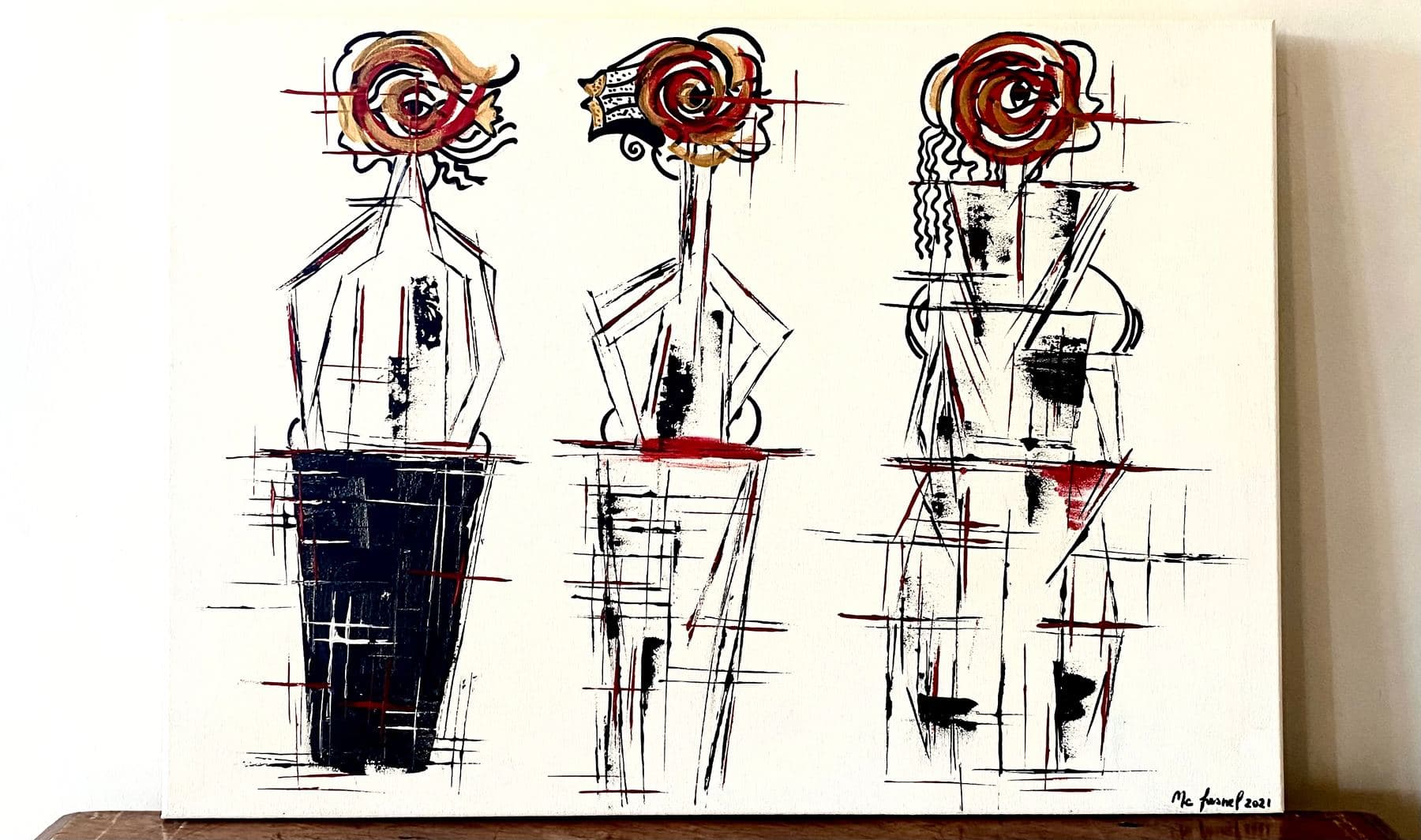
A crisp line or a spontaneous drip, a planned composition or an improvised gesture: geometric abstraction and lyrical abstraction are the two great languages of abstract painting since Kandinsky. Between Mondrian and Hartung, between rule and gesture, a geometric painter trained in Latin America explains what truly separates these two styles — and why her own work sits right at their border.
Standing in front of an abstract canvas, the question people ask most often isn't "what does it represent?" but "is this geometry or gesture?". Geometric abstraction and lyrical abstraction are the two great families that have shaped the history of abstract painting for more than a century — one built with a ruler and a set square, the other born from the wrist and the shoulder. In this new Journal article, I take the time to explain what really sets these two visual languages apart, their founding figures, and why my own work refuses to choose between them.
Two languages born from the same break with reality
Geometric or lyrical, abstraction always starts from the same founding gesture: freeing shape and colour from any obligation to represent the visible world. But once that freedom is won, two paths open up — and they sometimes coexist within a single painter's work. Wassily Kandinsky painted spontaneous, gestural Improvisations from 1910 onward, before developing, once settled at the Bauhaus in the 1920s, his far more constructed Compositions, where the circle, the triangle and the straight line obey an almost mathematical grammar. That single shift contains the whole tension between the two abstractions.
Geometric abstraction: the ruler, the line, the flat colour field
Geometric abstraction builds the canvas the way one builds a floor plan: clean shapes, controlled straight or curved lines, flat colour fields with crisp edges, a composition worked out before the brush ever touches the canvas. Piet Mondrian and his Neoplasticism, Kazimir Malevich and his Suprematism, and later Victor Vasarely and Op Art are its best-known European milestones — I trace that history in more depth in the article on kinetic art. In Latin America, that same rigour finds a very different chromatic climate in Joaquín Torres-García and the Concrete and Neo-Concrete movements, whose lineage I claim directly.
Lyrical abstraction: gesture, material, the instant
At the opposite end, lyrical abstraction turns gesture itself into the subject of the painting. The term was coined in France in the early 1950s to describe painters such as Georges Mathieu and Hans Hartung, who covered the canvas in drips, scratches and rapid gestures rather than planned shapes — sometimes also called Tachisme. At the same time, on the other side of the Atlantic, Jackson Pollock and Willem de Kooning developed a related approach under the name Abstract Expressionism, or action painting: the canvas becomes the arena for a physical, almost choreographic gesture rather than the support for a carefully considered composition.
Five cues for telling the two styles apart at a glance
- —Line — crisp and well-defined in geometric abstraction; fluid and uncertain in lyrical abstraction
- —Composition — planned in advance, often modular, in geometric work; improvised directly at the canvas, in lyrical work
- —The painter's gesture — controlled and almost invisible in geometric work; visible, rhythmic and personal in lyrical work
- —Colour — separated and contrasted flat fields in geometric work; blended, layered or splattered in lyrical work
- —Emotion suggested — order, calm and structure in geometric work; urgency, energy and spontaneity in lyrical work
I don't choose between the rule and the gesture: I let the knife trace a clean edge, then I let the colour overflow and blur the line.
My own painting, at the border of both abstractions
Trained in Buenos Aires and then São Paulo, I inherited the geometric rigour of the Latin American tradition — the same lineage that traces back to Torres-García, which I detail in the article on Latin American geometric abstraction. But my palette-knife work, far from freezing the composition, also lets gesture in: material overflows, colour runs from one field into the next, and the canvas keeps the trace of my arm's movement. Works such as Mutation or Passage Flou show that more lyrical, fluid side of my practice, while Équilibre stays anchored in a firmer geometric construction. You can compare both tendencies by browsing my work in the Full Collection, or come see them in person at an upcoming exhibition in France, Spain or Andorra, announced on the News page.
Tags
Frequently Asked Questions
How can you tell geometric and lyrical abstraction apart at a glance?+
Start with the edges of the shapes: crisp outlines and straight lines point to geometric abstraction, while blurred edges, drips or splatters signal lyrical abstraction. Composition offers a second clue — the more it looks planned in advance, the more geometric it is; the more it looks born in the moment, the more lyrical it is.
Who are the key artists of French lyrical abstraction?+
The term is associated above all with Georges Mathieu and Hans Hartung, whose 1950s canvases favour rapid gesture and drips over construction. They're sometimes linked to Tachisme, a related strand centred on the stain and the splatter rather than gestural line as such.
Is lyrical abstraction the same thing as American Abstract Expressionism?+
They're parallel movements rather than identical ones, born around the same time on either side of the Atlantic. Lyrical abstraction refers to the French and European scene (Mathieu, Hartung), while Abstract Expressionism — or action painting — describes its New York counterpart, embodied by Pollock or de Kooning. Both share a primacy of gesture, but they belong to distinct artistic contexts.
Can a single painting combine geometric and lyrical abstraction?+
Yes — and that's exactly what I look for in my own work: lines and colour fields built with a palette knife, crossed by more fluid, spontaneous movements of colour. Many contemporary artists today compose at the border of both traditions rather than locking themselves into one.
Discover the works
Browse the full collection of original abstract paintings by M. C. Lamamie de Clairac.
View the Collection →