The Journal
How to Pair an Abstract Painting with Your Home Decor: Size, Colour and Placement
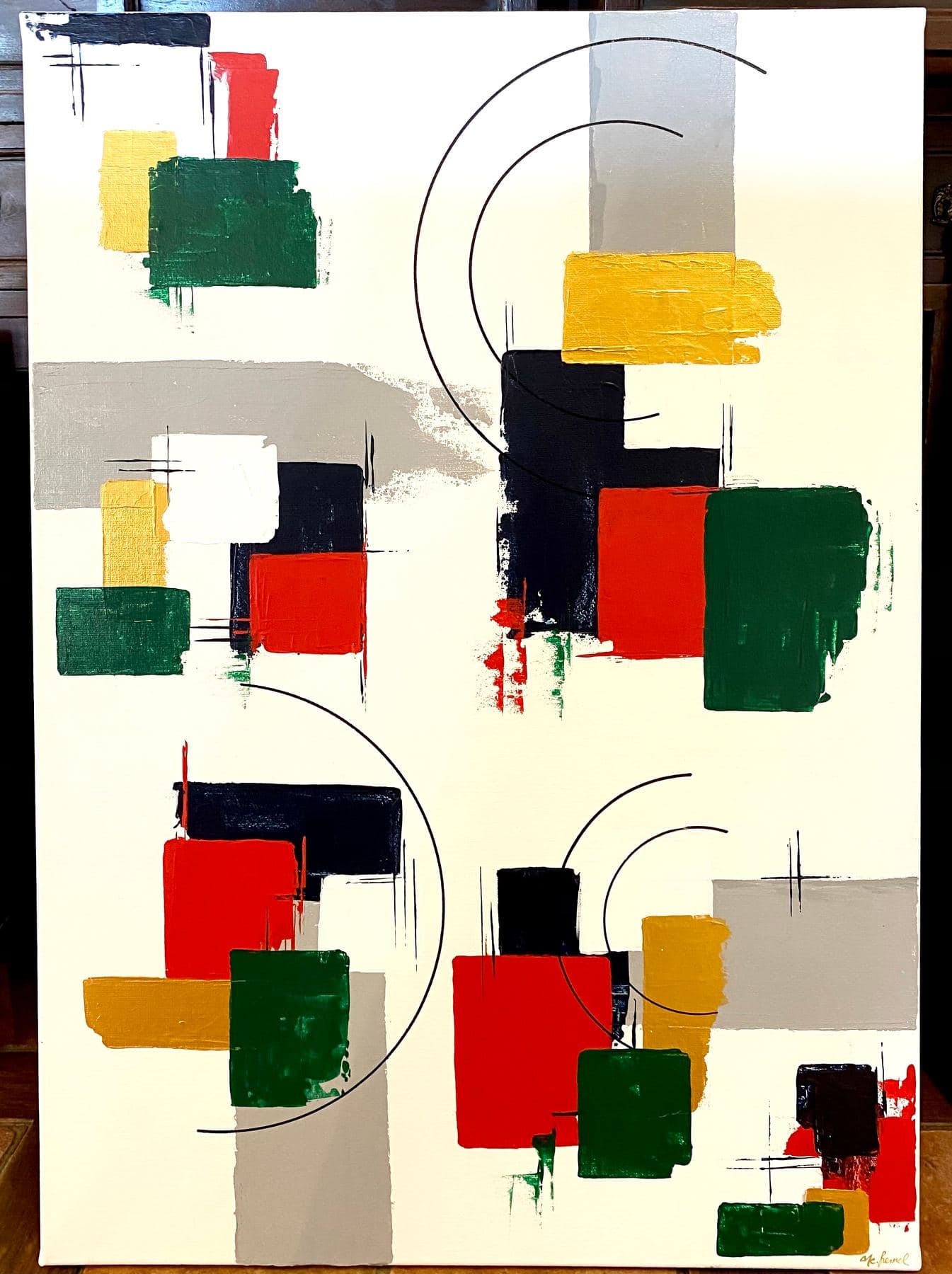
Size, colour, hanging height, light: practical, concrete advice for choosing and hanging an abstract painting at home, from living room to bedroom, from my studio in the Tarn.
"Would this work above my sofa?" Standing in front of a canvas at an exhibition, hands already sketching out the width of the wall waiting at home, that's often the first question visitors ask — before price, before technique. Choosing an abstract painting for your home doesn't have to be a gamble: a handful of simple markers — size, colour, hanging height, light — are usually enough to turn a first instinct into the right choice for the space that will actually hold it. As a painter working in bold, colourful geometric abstraction from my studio in the Tarn, here's how I think about hanging a canvas at home myself.
Why abstract art fits (almost) any interior
Unlike a figurative painting, which imposes a subject — a face, a landscape, a scene — an abstract canvas tells nothing literal: it brings colour, rhythm and texture without ever competing with existing furniture or architecture. That's why it works just as well in a clean-lined contemporary interior as in an old stone house with exposed beams: a geometric composition converses with modern volumes, while a more fluid, colourful abstraction warms up a more traditional space. The real question is never "does this style of painting suit my decor?" but rather "what size, colour and texture suit this particular space?"
What size abstract painting suits which room?
A canvas's size matters at least as much as its subject. In a living room, where a painting often becomes a focal point visible from across the whole space, large formats tend to work best: my canvases Jumeaux (160×90 cm) and Équilibre (120×100 cm) show exactly that role — a centrepiece able to anchor an entire wall above a sofa or a low sideboard. In a bedroom, where calm matters more than visual impact, a mid-size canvas and a more restrained palette usually work better — a monochrome piece like Blanc Immaculé (90×65 cm) or Brume (70×50 cm) sits naturally there. In an entryway or hallway, often narrow, a vertical, more intimate format, somewhere between 50×70 cm and 70×50 cm, accompanies the passage without crowding it. One simple rule applies everywhere: let the canvas breathe, with at least 10 to 15 cm of visible wall around it.
Five ways to match an abstract painting's colours to your interior
Once you've settled on size, colour is usually the next question. Here are five simple ways to get it right:
- —Choosing the painting first and building the room around it is often easier than the reverse — a single colour pulled from the canvas is enough to guide cushions, curtains or a rug
- —In a room already busy with colour and pattern (printed fabrics, wallpaper), a monochrome or a tighter palette calms the whole space rather than adding to the noise
- —In a neutral room (white or grey walls, understated furniture), a bold, contrasting canvas such as Reflets de Joie or Synthèse d'Or can become the only colour statement you need
- —Undertones matter as much as colour itself: a canvas in warm tones (red, orange, gold) warms up a north-facing room, while one in cool tones (blue, green) freshens a very sunny space
- —Natural light changes how colour reads throughout the day — it's always worth looking at a painting in your own home, at different hours, before settling on its final spot
What height to hang an abstract painting, and why light changes everything
Hanging height follows a fairly universal rule in interior design: the centre of the canvas should sit between 145 and 150 cm from the floor, roughly standing eye level — except above a sofa or a low piece of furniture, where it's better to leave 20 to 25 cm between the top of the furniture and the bottom of the frame. For palette-knife canvases like Équilibre or Nuit d'Été, light plays an extra role: the thickness of the paint and the relief left by the knife catch light differently depending on the time of day or the angle of a lamp, which makes the painting genuinely change character over the course of a day. Good accent lighting, angled slightly rather than head-on, brings out that relief without flattening it — but direct sunlight is worth avoiding, since it can dull acrylic colours over time.
My canvases, made to live in a home — from living room to bedroom
When I paint, I rarely have a specific wall in mind — but I always think about how a canvas will actually be used once it's hung: a large, colourful composition to carry a living room, a more restrained piece to accompany rest in a bedroom, a vertical format to structure an entryway. The Full Collection, organised by category — colourful, monochrome, figurative — with each work's dimensions listed, lets you search directly for the size and palette that suit your space. If nothing in the existing collection matches your exact dimensions, I also take on custom commissions, tailored to your space and palette — feel free to get in touch to discuss one. And if you'd rather see the texture and colours up close before deciding, the News page lists my upcoming exhibitions across France, Spain and Andorra.
I always think about the hand that will hang the canvas, not just the wall that will hold it — a painting is never really finished until it lives in the space that receives it.
Tags
Frequently Asked Questions
What size abstract painting should I choose for a sofa or living room?+
As a general rule, the painting's width (or the width of a grouped set) should be roughly two-thirds the width of the sofa or piece of furniture it hangs above. For a 200 cm sofa, a canvas between 120 and 140 cm wide creates a balanced look — wide enough to register, not so wide it overwhelms the furniture.
How do I match an abstract painting's colours to an already-furnished room?+
The simplest approach is to spot a colour already present in the room — a cushion, a rug, a door — and choose a canvas that picks it up or echoes it, without needing to match it exactly. In a room already rich in colour and texture, a monochrome painting often brings more balance than a highly coloured one.
What height should an abstract painting be hung at?+
The centre of the canvas should generally sit between 145 and 150 cm from the floor, close to standing eye level. Above a sofa or sideboard, it's better to leave 20 to 25 cm between the furniture and the bottom of the frame rather than sticking rigidly to that rule.
Can several abstract paintings be grouped on one wall?+
Yes, as long as there's a common thread — a shared colour palette, or a deliberate contrast between a colourful canvas and a monochrome one. It helps to lay the grouping out on the floor before hanging anything, keeping an even 5 to 8 cm gap between pieces.
Can I commission a custom-sized painting for a specific space?+
Yes — alongside the works already available in the Full Collection, I also take custom commissions tailored to a specific space and colour palette. The easiest way to start is to get in touch directly with your wall's dimensions and your preferred colours.
Discover the works
Browse the full collection of original abstract paintings by M. C. Lamamie de Clairac.
View the Collection →