The Journal
What Size Art Should Go Above a Sofa? A Practical Proportion Guide
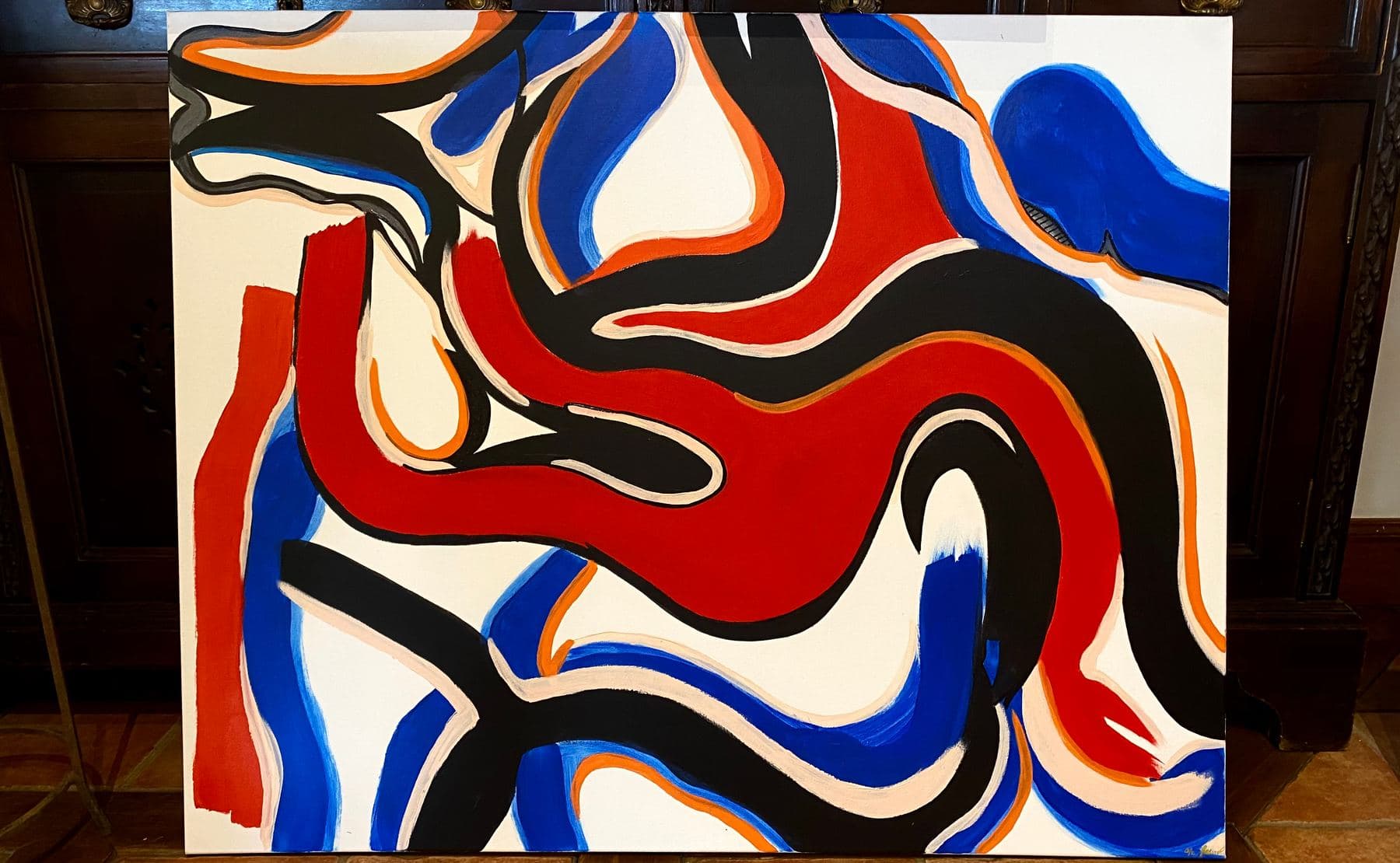
Art above a sofa should relate to the furniture rather than float on the wall. Use these measurements, layouts and real-canvas examples to choose an original painting at the right scale.
To size art above a sofa, first measure the sofa from arm to arm. The painting — or the full group of works — can span roughly 60 to 75% of that width. Over a 200 cm (79 in) sofa, that means art about 120 to 150 cm (47 to 59 in) wide. Then leave 15 to 25 cm (6 to 10 in) between the sofa back and the bottom of the canvas. These are useful starting points rather than fixed laws, but they prevent the most common mistake: choosing art that is too small and hanging it too high.
Measure the sofa, not the whole wall
The eye naturally groups a painting with the furniture below it, so the sofa sets the scale even when the wall stretches much farther. Measure its real width, multiply by 0.60 and again by 0.75, and treat the results as a range. A dark, highly contrasted or heavily textured painting carries more visual weight and may work near the lower end; a lighter composition can often occupy more width without overpowering the room.
- —160 cm (63 in) sofa: art 95–120 cm (37–47 in) wide
- —180 cm (71 in) sofa: art 110–135 cm (43–53 in) wide
- —200 cm (79 in) sofa: art 120–150 cm (47–59 in) wide
- —220 cm (87 in) sofa: art 135–165 cm (53–65 in) wide
- —240 cm (94 in) sofa: art 145–180 cm (57–71 in) wide
Landscape, square or portrait: shape changes the balance
A landscape canvas extends the sofa's horizontal line and works especially well with long seating or low ceilings. A large square creates a more concentrated anchor and can suit a compact sofa, provided it does not look timid in width. Portrait art can be striking in a tall room, but it covers less of the sofa's span; pair it with a second work or make the asymmetry deliberate. The useful question is not only 'how many inches?' but 'which silhouette answers the shape of the sofa?'.
One large painting or a group?
A single original gives the room a clear visual centre and lets the artist's colour, material and gesture hold attention. A diptych, triptych or gallery wall can cover the same width, but measure the complete arrangement including the gaps. Keep those gaps consistent — often 5 to 8 cm (2 to 3 in) between substantial canvases — and give the pieces a shared logic through palette, shape, horizon or intensity. With heavily textured original painting, I often prefer one canvas: light can travel across the relief and the viewing experience stays whole.
A painting does not need to fill the wall; it needs to give the sofa and the space around it a proportion that feels inevitable.
How high should art hang above a sofa?
Leave about 15 to 25 cm (6 to 10 in) between the top of the sofa and the bottom of the canvas. Beyond 30 cm (12 in), the art often begins to float away from the furniture. The familiar rule of placing the centre at eye level — roughly 145 to 150 cm (57 to 59 in) from the floor — remains useful on an empty wall, but the relationship with the sofa matters more here. Allow for seated heads, tall cushions and nearby lamps. For palette-knife work, angle a light slightly across the surface so it reveals the relief instead of flattening it with frontal glare.
Test the proportions before buying or drilling
Cut a rectangle from kraft paper, tape newspaper sheets together or outline the dimensions with low-tack painter's tape. Leave the mock-up in place for a day and view it from the doorway, an armchair and your usual seat. Then take a photograph: a screen makes undersized or off-centre art surprisingly obvious. If you are between two sizes, test both. This is especially useful for a commission, because it turns a vague feeling into exact dimensions you can discuss with the artist.
Real dimensions from my collection
In my Collection, Équilibre measures 120 × 100 cm (47 × 39 in), giving it enough presence for a sofa around 180 to 200 cm wide, particularly where wall height matters as much as width. The panoramic Jumeaux, at 160 × 90 cm (63 × 35 in), is better matched to a 220–240 cm sofa or an open living area. Joie de Paris is 160 × 100 cm (63 × 39 in) and its vivid colour gives it even greater visual weight. These examples cannot replace testing in your own room, but they show why dimensions, orientation and compositional density need to be considered together. Browse the full Collection, or contact me with your sofa width and a photograph of the wall to discuss an available work or a made-to-measure commission.
Tags
Frequently Asked Questions
What size art should go above a 200 cm or 79-inch sofa?+
Aim for a total width of roughly 120 to 150 cm (47 to 59 in), or 60–75% of the sofa. Dense, dark art can work near the lower end; a visually lighter composition can extend toward the upper end.
How much space should be left between a sofa and wall art?+
Leave about 15 to 25 cm (6 to 10 in) between the sofa back and the bottom of the artwork. This keeps them visually connected while protecting the canvas from cushions and contact.
Should wall art be centred over the sofa or the wall?+
Usually centre it over the sofa, because the eye reads them as one arrangement. An intentional offset can work when a lamp, shelf or second artwork balances the composition.
Can portrait art work above a sofa?+
Yes, particularly in a room with high ceilings. Make sure it does not look too narrow against the sofa; a second portrait piece or a deliberate asymmetrical layout can restore balance.
How can I preview an artwork at home before buying it?+
Mark its exact dimensions on the wall with paper or low-tack painter’s tape, then view the mock-up from several positions. A straight-on photograph also makes scale, height and centring easier to judge.
Discover the works
Browse the full collection of original abstract paintings by M. C. Lamamie de Clairac.
View the Collection →