The Journal
Masking Tape in Abstract Painting: The Technique for Clean Geometric Lines
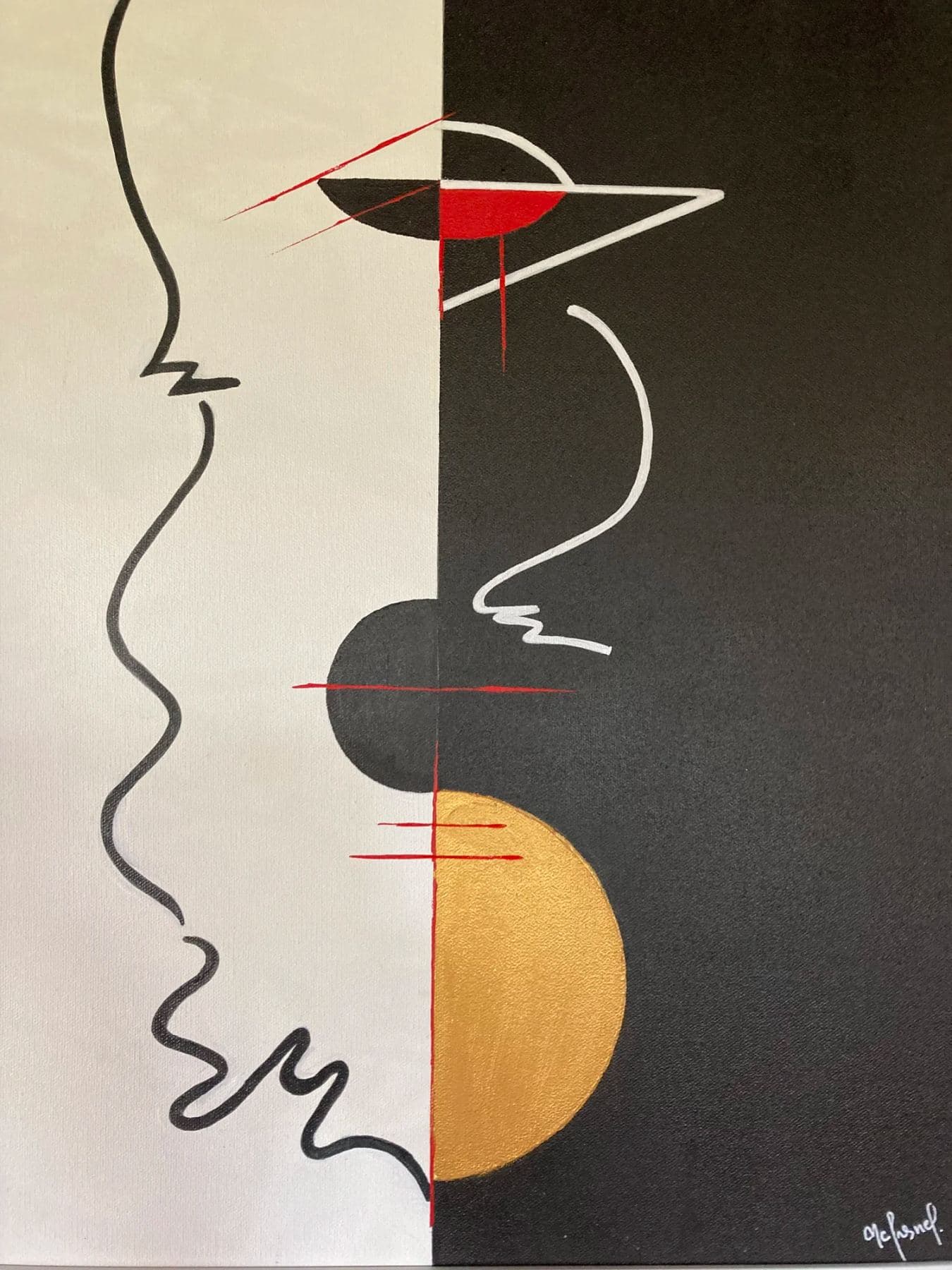
"How do you get lines that straight, without a single bleed?" Borrowed from the American hard-edge painters, masking tape remains the most reliable tool for perfectly crisp geometric colour fields. An artist who works her own lines freehand breaks down the technique, the materials and the mistakes to avoid.
"How do you get lines that straight, without a single bleed?" It's a question I hear often in front of a strongly geometric abstract canvas — and the answer, most of the time, comes down to a simple roll of tape. Masking tape, borrowed from the building trade, has been a go-to tool for decades among painters who work in flat colour and straight lines. In this new Journal article, I explain what the technique is, how it made its way into abstract painting studios, and how to use it to get perfectly clean edges on an acrylic canvas.
What is masking tape in abstract painting?
Masking tape, in this context, is any low-tack adhesive strip applied to the canvas before painting, to protect an area and leave, once peeled away, a perfectly straight edge between two colours or two shapes. Unlike a line painted freehand, however steady the hand, tape removes any hesitation: it turns a painterly gesture into a mechanical boundary, accurate to the millimetre. For a geometric abstraction built from flat colour fields — triangles, bands, a circle split cleanly in two, as in my painting Double Visage — that precision becomes a compositional tool in its own right, not just a technical shortcut.
From the building site to the studio: a tool that defined hard-edge painting
Masking tape didn't start out as an art-studio tool: it comes from construction and auto body work, where it protects a surface before paint or varnish is applied. It was American hard-edge painters in the 1950s and 60s — Ellsworth Kelly, Kenneth Noland, Frank Stella — who adopted it to push the logic of the perfectly bounded colour field as far as it would go, with no gradient and no visible trace of the brush. Their bet: a line so clean it stopped pointing back to the hand that painted it, becoming an almost industrial shape instead. The technique has long since spread well beyond that specific movement to become a staple of geometric abstract painting today, for hobbyists and professionals alike.
Which tape to choose, depending on canvas and paint
- —Standard crepe-paper painter's tape, low to medium tack — the most versatile option, suited to most primed canvases
- —"Anti-bleed" tape, with an edge treated by a gel that swells slightly on contact with paint and seals micro-gaps — the most reliable choice on a textured canvas
- —Washi tape, thinner and gentler, useful for soft curved lines or fragile surfaces, though less watertight against very liquid paint
- —A craft knife or fine-blade scalpel, to cleanly re-cut the tape's edge before painting, especially on complex angles
- —A burnishing tool — the back of a spoon or a stiff plastic card works fine — to press the tape firmly and push out any trapped air
Step by step: getting perfectly clean lines
- —Work on a clean, fully dry canvas: the smallest trace of dust or moisture under the tape will cause a bleed
- —Lay the tape down in one continuous pull along its full length, without stretching it too tight, so it doesn't lift as it dries
- —Burnish every centimetre of the edge firmly with a flat tool — the one step that actually keeps paint from creeping underneath
- —Apply a thin coat of the existing background colour along the tape's edge first, to seal any micro-gaps before the final colour goes on — the single most effective trick against bleeding
- —Paint the intended colour from the tape's edge inward, never the other way round, so you never push paint under the adhesive
- —Peel the tape away slowly, at an angle close to 45 degrees, while the paint is still slightly tacky to the touch — never once it's fully dry, or it will pull off a fragment of paint with it
A line drawn with tape never lies — which may be exactly why I usually prefer to let mine tremble a little: that's where the hand still shows.
In my own practice: a clean line without tape
I recommend masking tape without reservation to anyone starting out in geometric abstraction: it makes a precision available from the very first canvas that would otherwise take years of practice to earn. In my own work, though, I rarely reach for it. My training in painting, ceramics and pottery between Buenos Aires and São Paulo taught me to build a clean line directly with brush or palette knife, in successive blocks and without a preparatory sketch — a method I describe in the Journal article on the creative process behind an abstract painting. That freehand line is never quite as absolutely straight as a taped one: seen up close, it keeps a slight tremor I never try to correct. You can see that tension between geometric rigour and living material in canvases like Double Visage or Ville Cubique, on view in the Full Collection, and in person at an upcoming exhibition in France, Spain or Andorra, listed on the News page.
Tags
Frequently Asked Questions
Which masking tape should I choose for painting on acrylic canvas?+
Standard crepe-paper painter's tape, low to medium tack, works for most primed canvases. On a textured canvas or one built up with a palette knife, an "anti-bleed" tape, whose treated edge limits paint creeping underneath, is the more reliable choice.
How do you stop paint from bleeding under masking tape?+
The decisive step is to firmly burnish the tape's edge with a flat tool before painting, then apply a thin coat of the existing background colour along that edge first: it seals the adhesive's micro-gaps before the final colour goes on.
Should you remove masking tape while the paint is wet or once it has dried?+
It's best to peel it away while the paint is still slightly tacky to the touch, slowly and at an angle close to 45 degrees. Fully dried paint is more likely to crack and lift off along with the tape.
Does masking tape damage an acrylic canvas?+
No, as long as it is a low-tack tape designed for painting, applied to an already-dry canvas and removed within a few hours. An overly sticky tape, or one left on too long, can pull away a bit of paint as it dries.
Can masking tape be used on surfaces other than canvas?+
Yes, the technique also works on wood or paper, as long as the tape's tack is matched to how delicate the surface is — I cover this in more detail in the Journal article on choosing a support for abstract acrylic painting.
Discover the works
Browse the full collection of original abstract paintings by M. C. Lamamie de Clairac.
View the Collection →