The Journal
Palette Knife Painting: Technique, How It Differs from Brushwork, and Care
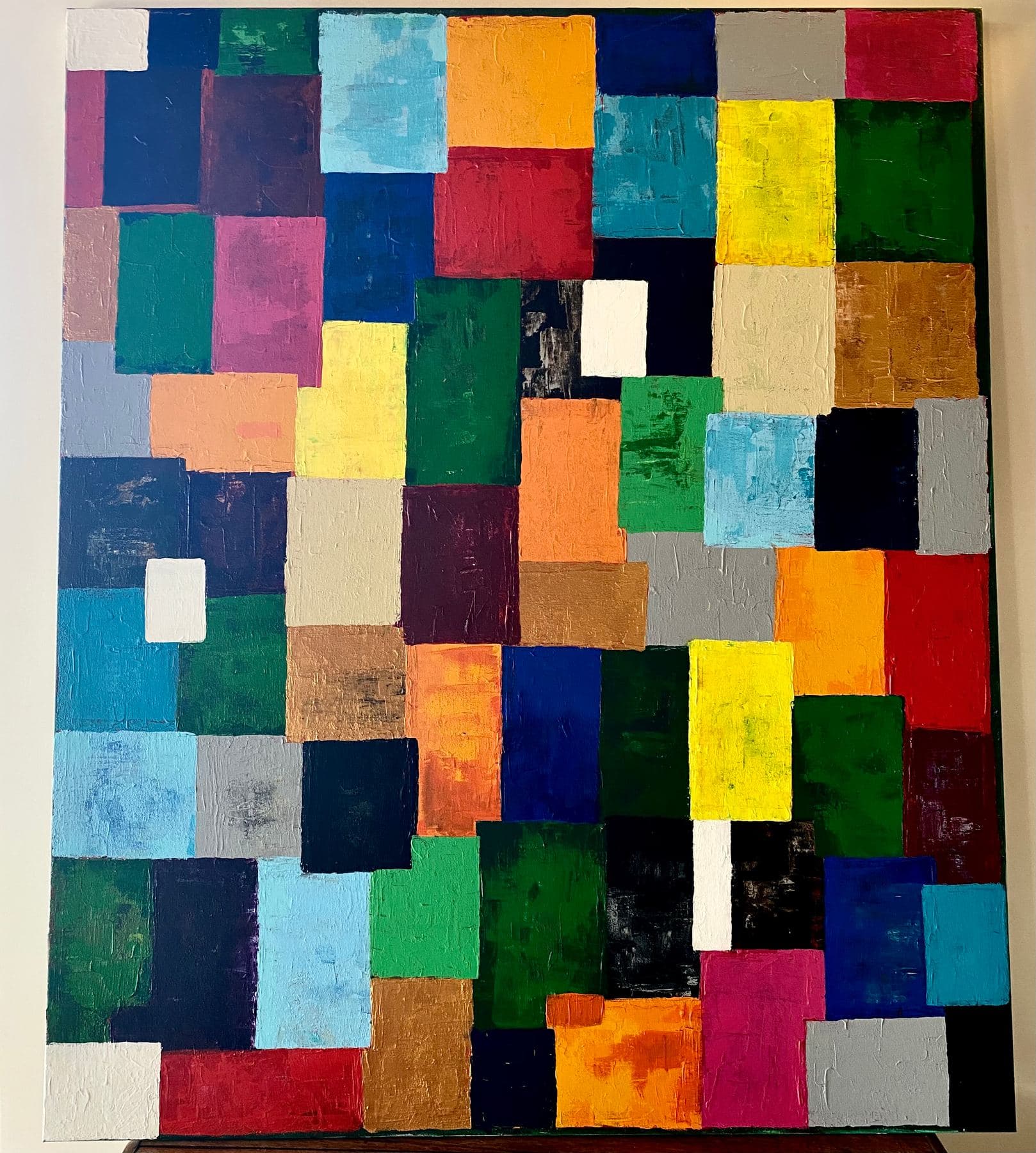
What is palette knife painting? Between Courbet's legacy and contemporary geometric abstraction, a look at a technique that gives canvas relief, material and light.
Under a living room lamp or the lights of a gallery wall, some canvases don't just display colour: they cast a shadow, a ridge, a relief that shifts with the angle you're standing at. That's the signature of the palette knife, a tool inherited from the 19th century that contemporary abstract art has turned into a language of its own. In this new Journal piece, I walk you through palette knife painting: what it is, where it comes from, how it differs from brushwork, and how it still shapes my geometric abstraction today.
What is palette knife painting?
Unlike a brush, which lays down paint in successive, often blended strokes, a palette knife — a thin, flexible blade, usually metal or plastic, with no cutting edge — spreads it, scrapes it, layers it and sculpts it directly onto the canvas. The material stops being just colour: it becomes relief, a thickness that light reveals differently depending on the time of day or the viewing angle. The gesture is also more direct and physical: every pass leaves a clean ridge, a groove, a sharp edge that doesn't soften the way a brush stroke would.
A 19th-century technique, reinvented by contemporary abstraction
The palette knife isn't an invention of abstract art: it was Gustave Courbet who, in the mid-19th century, popularised its use to build powerful impasto in his realist landscapes, soon followed by Impressionists chasing material and light. Vincent van Gogh pushed it further still, layering paint to give his canvases an almost sculptural vibration. But it's with 20th-century abstraction — abstract expressionism and geometric abstraction in particular — that the knife becomes a compositional tool in its own right: held flat, it lays down clean fields of colour and straight lines; tilted, it creates gradients and organic textures. Within the geometric abstraction inherited from the Latin American concrete tradition, the knife delivers exactly what a brush alone cannot: sharp edges that structure a composition while keeping the vibration of the material.
Palette knife or brush: what's the real difference?
- —Material — the knife lays down thick, textured layers, while the brush allows fine, transparent or blended glazes
- —Edges — the knife traces clean, geometric ridges; the brush leaves softer transitions
- —Drying time — a thick knife layer takes longer to dry than a thin brushed one, especially in acrylic
- —Control of gesture — the knife imposes a broader, more direct motion, less suited to fine detail
- —Light effect — the knife's relief catches light and shifts appearance depending on lighting, an effect impossible on a flat surface
How to recognise a palette-knife painting
A few visual cues rarely lie:
- —Visible relief, sometimes several millimetres deep, casting a faint shadow across the canvas
- —Clean, almost carved edges, where a brush would leave a softer outline
- —Fully opaque patches next to thin streaks where the canvas or underlayer still shows through
- —An appearance that shifts noticeably with viewing angle and light, natural or artificial
- —The absence of visible brushstrokes, replaced by broader planes and ridges
My geometric abstraction with the palette knife
In my work, the knife is never a mere stylistic effect: it serves the geometric construction of the canvas. Held flat over broad colour fields, it structures the clean lines rooted in my training between Buenos Aires and São Paulo; used in light relief along the edges of a composition, it makes the boundary between two colours vibrate and sharpens the visual tension typical of my work. Paintings such as Équilibre, Synthèse d'Or, Soleil Prédominant, Tempête and Blanc Immaculé all carry this knife signature, each with a different balance between raw material and controlled gesture.
The knife doesn't hide the material — it reveals it.
You can see this material work up close by browsing the Full Collection, or discover where I have exhibited these pieces across France, Spain and Andorra on the News page.
Caring for and displaying a textured palette-knife painting
A canvas with pronounced relief calls for a few simple precautions. Avoid hanging it under glass: the pane would flatten the relief and create reflections that hide the material — an open frame, or the canvas on its stretcher with no glazing at all, lets the texture breathe instead. For cleaning, a soft, dry cloth is usually enough to remove dust; avoid any liquid or solvent-based product, which could damage the acrylic layer, especially on the thickest areas, where full curing can take several weeks after completion. Finally, think about lighting: raking light, rather than direct frontal light, brings out the relief and lets the painting change character throughout the day.
Tags
Frequently Asked Questions
What exactly is palette knife painting?+
Palette knife painting is a technique where paint is applied, spread or scraped with a flexible blade instead of a brush, creating relief and texture that colour alone can't provide. It's used in both figurative and abstract painting, where it often helps structure the composition.
What's the difference between painting with a knife and with a brush?+
A knife lays down thicker material with clean edges and visible relief, while a brush allows fine glazes, soft gradients and more detail. I often combine both tools within the same canvas depending on the effect I'm after.
How do you clean a textured acrylic painting made with a palette knife?+
A soft, dry or lightly damp cloth is usually enough to remove dust from the surface. Avoid any solvent- or alcohol-based product, which could dull or weaken the acrylic layer, especially on the thickest relief.
Should a palette knife painting be framed under glass?+
No, this generally isn't recommended: glass flattens the relief and creates reflections that hide the material. Most of my knife-painted works are displayed on their stretcher, without glazing, so the texture can breathe.
Which of M. C. Lamamie de Clairac's paintings use the palette knife technique?+
Several of my canvases, including Équilibre, Synthèse d'Or, Soleil Prédominant, Tempête, Nuit d'été and Blanc Immaculé, are made with acrylic and palette knife. They can be seen in the site's Full Collection.
Discover the works
Browse the full collection of original abstract paintings by M. C. Lamamie de Clairac.
View the Collection →