The Journal
The Creative Process Behind an Abstract Painting: From Blank Canvas to Finished Work
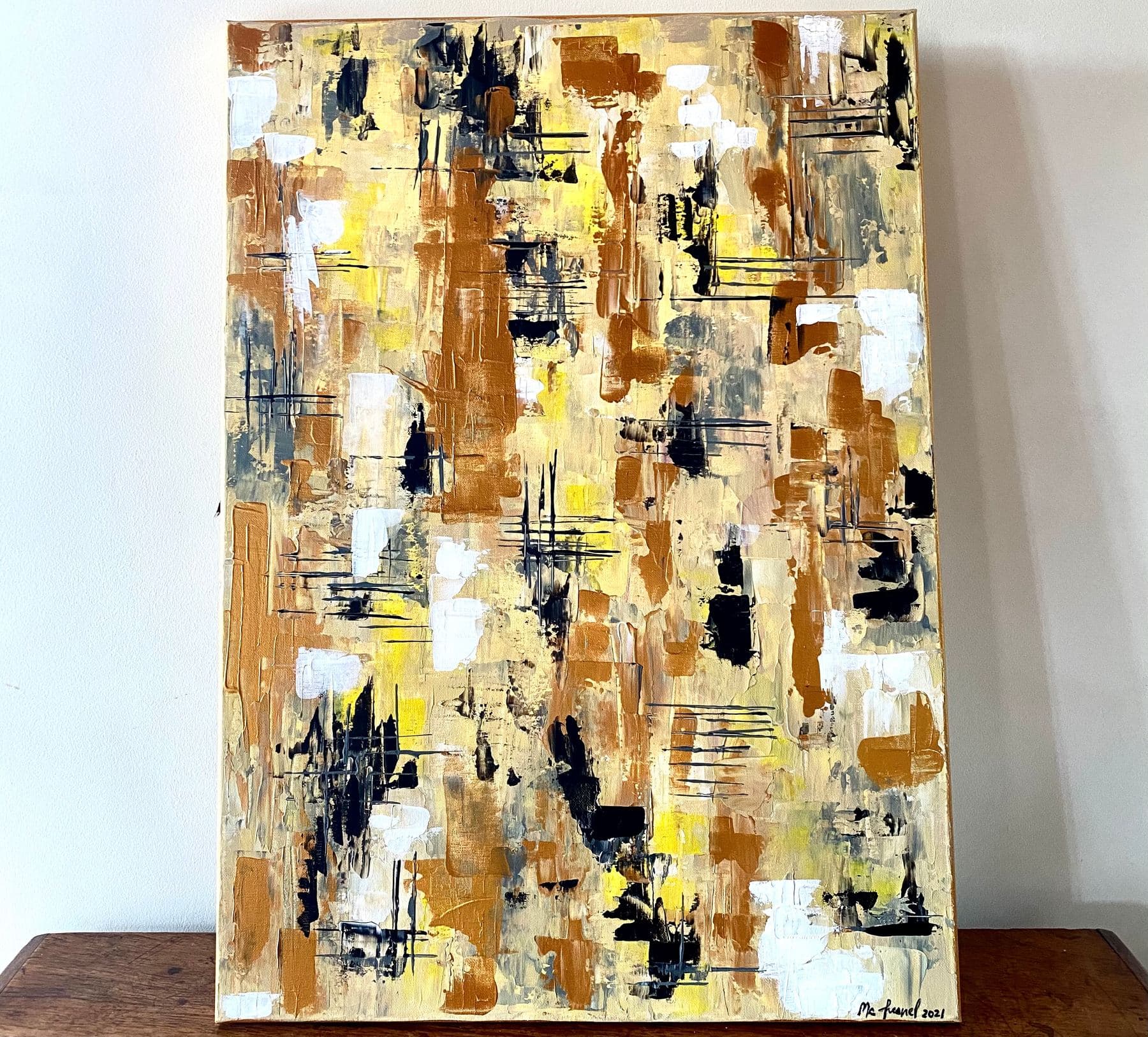
A blank canvas on the easel, a tube of acrylic just opened, and then hours of layering and palette-knife work before a composition finally feels complete. How does an abstract painting actually come together? Step by step, a geometric painter trained between Buenos Aires and São Paulo walks through her creative process, from the first intention to the always-tricky moment of knowing a canvas is done.
A blank canvas propped on the easel, a tube of acrylic paint just opened, and nothing else but a single gesture — the first in a long sequence that, hours or sometimes days later, will end in a composition I finally consider finished. The creative process behind an abstract painting remains something of a mystery to anyone who has never held a palette knife: unlike a figurative work, there is no model to copy and no preparatory sketch to fill in with colour. In this new Journal article, I walk through, step by step, how an abstract painting actually comes together in my studio in the Tarn — from the first intention to the always-delicate moment of knowing a canvas is truly finished.
The starting point: a blank canvas and an intention
I never start from a fixed sketch or a photograph to reproduce. The starting point is closer to an intention: a colour palette I've been turning over for days, a chromatic contrast I want to test, or simply the wish to recapture a feeling — the light of a Brazilian memory, the energy of a Buenos Aires street. That intention stays deliberately open: it sets a direction, not a result. It's the canvas itself, as the first layers go down, that gradually tells me where to go next.
Composing without a preparatory sketch: geometry and intuition
Trained in painting between Buenos Aires and São Paulo, I inherited a very geometric relationship to composition: the canvas is almost always thought through in flat colour fields, lines of force and zones that respond to one another, rather than as a sequence of details. I don't pencil in the composition before painting — I build it directly in paint, block by block, stepping back regularly to judge the overall balance of the canvas. It's a constant dialogue between intuition, which guides the first gesture, and a more analytical eye, which checks whether the masses of colour and the contrasts hold together.
Building the surface: acrylic layers and palette-knife relief
Once the overall composition is in place, the work turns more physical. I work exclusively in acrylic, for its fast drying time, which lets me layer several passes in a single session — unlike oil, which forces you to wait several days between each one. On many canvases, such as Synthèse d'Or, Équilibre or Nuit d'été, I set the brush aside for the palette knife: paint applied thickly keeps the trace of the gesture and creates a relief that light reveals differently depending on the hour and the viewing angle. This stage can repeat over several sessions, each new layer correcting, thickening, or deliberately contradicting the one before it.
The stages of creation, in order
- —Intention: a palette, a contrast or a feeling to explore, with no preparatory sketch
- —Composition: built directly in paint, in flat colour fields and lines of force
- —Laying in colour: first acrylic layers, often with a brush, to set the main masses
- —Working the surface: palette-knife passes, thickness and relief, sometimes across several sessions
- —Stepping back: the canvas is set aside and viewed from a distance and under different light, for days if needed
- —The final decision: stop adding, sign, then name the work
A canvas is never finished for lack of time — it's finished the moment adding anything more would take something away from it.
Knowing when a canvas is finally finished
It's probably the question I'm asked most often in the studio: how do you know an abstract painting is finished, when there's no fixed model to reach? There's no absolute rule, but one fairly reliable signal keeps coming back: the moment I stop looking at the canvas to decide what to add, and start looking at it only to check that nothing needs to come off. As long as some area still calls for a correction, the canvas keeps going. The day I look at it without feeling that pull — when the contrast, the surface and the balance hold together without any detail demanding attention — I know that adding one more layer would damage what's already been built. That precise moment is, to me, the real end of the creative process, far more than any count of hours or layers.
From the studio in the Tarn to the walls of Occitanie, Madrid and Andorra
I repeat this process, canvas after canvas, from my studio in the Tarn, near Toulouse. Some works born this way — Synthèse d'Or, Équilibre, Blanc Immaculé — can be seen today in the Full Collection, alongside more than forty original paintings organised by colourful, monochrome or figurative register. Others have travelled beyond the studio: exhibited in Madrid, in Canillo, Andorra, or across several towns in Occitanie, as traced on the News page, which records all of my exhibitions since 2021. Seeing a canvas in person, with its relief and the way the light shifts across it depending on the angle, remains the best way to understand what hours of palette-knife work can actually produce.
Tags
Frequently Asked Questions
How does an abstract painting come together without a model to copy?+
The process starts from an intention — a colour palette, a contrast or a feeling to explore — rather than a preparatory sketch. The composition is built directly in paint, layer by layer, until the balance between colour and surface feels right.
How long does it take to paint an abstract painting?+
It varies enormously with the size and the number of layers: some canvases come together in a single intense session, others take several days or weeks, with time to step back between passes and judge the overall balance of the composition.
How do you know when an abstract painting is finished?+
There's no universal rule, but one reliable signal: a canvas is finished when you stop looking for what to add and start checking only that nothing needs to be removed. If no area still calls for correction, adding another layer risks damaging the balance already achieved.
Why do some abstract paintings have so much texture?+
That relief usually comes from palette-knife painting, a technique that applies acrylic thickly rather than in thin brushed layers. The paint keeps the trace of the gesture and catches light differently depending on the angle from which the canvas is viewed.
Discover the works
Browse the full collection of original abstract paintings by M. C. Lamamie de Clairac.
View the Collection →