The Journal
Understanding Abstract Painting: Origins, Techniques and a Contemporary Perspective
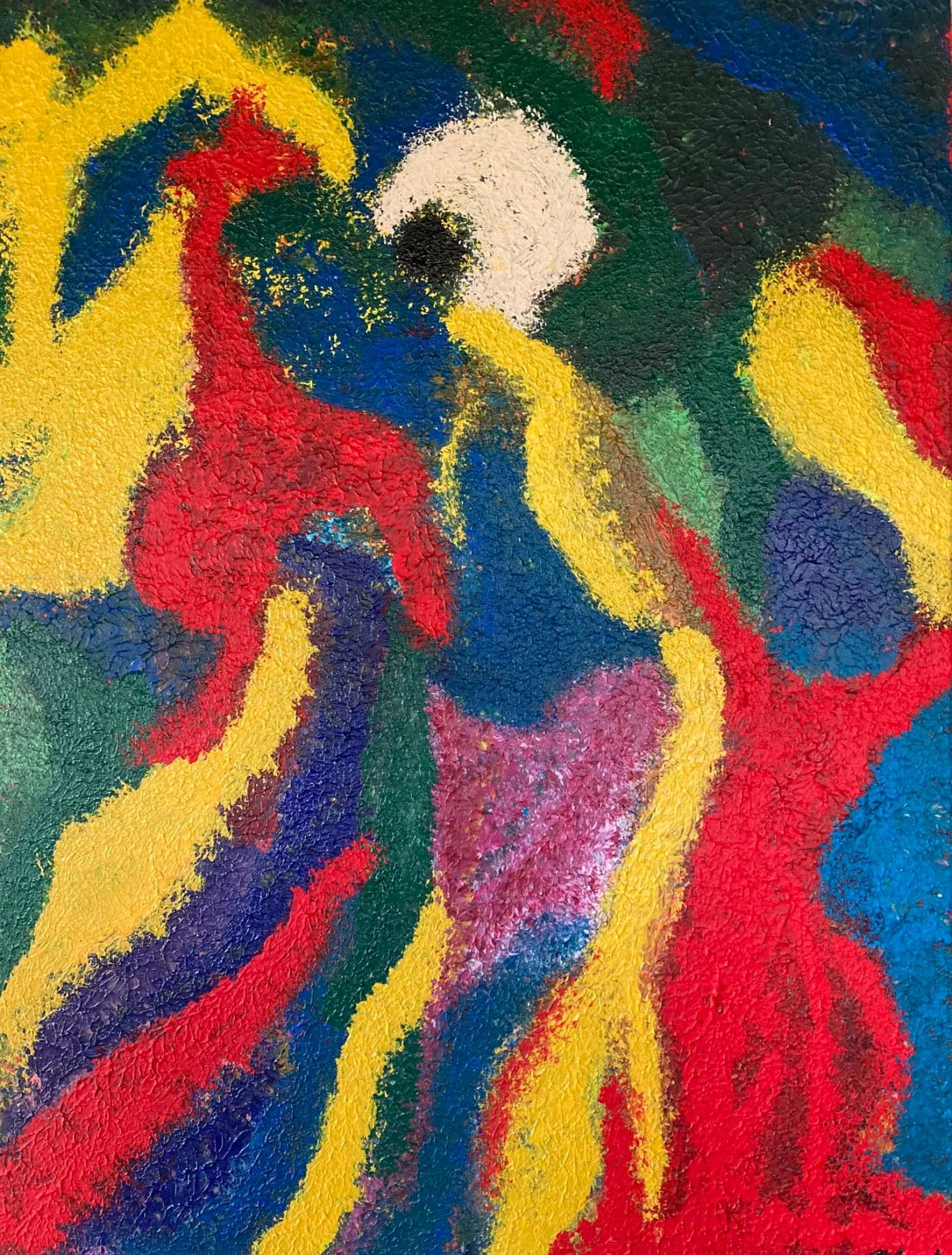
What is abstract painting? From Kandinsky's legacy to geometric abstraction inspired by Latin American colour, a journey through an art form that frees shape and colour from figurative representation.
A canvas where colour explodes without ever forming a face, a landscape, or any recognisable object — that, in a single image, is abstract painting. Long seen as difficult to access, this art form that reshaped the 20th century still fascinates collectors, interior designers and colour lovers alike today. In this article — the first of a series we'll be dedicating to contemporary art — we explore what defines abstract painting, where it comes from, how it's made, and above all, how to look at it and truly appreciate it.
What is abstract painting?
Abstract painting refers to any work that moves away from a faithful representation of reality to foreground shape, colour, line and material as subjects in their own right. Two broad families are usually distinguished: geometric abstraction, built from clean shapes, structured compositions and flat colour fields — think Kandinsky or Mondrian — and lyrical abstraction, more gestural and spontaneous, where the painter's gesture takes precedence over construction, as with Pollock or de Kooning. Between the two, like many contemporary artists, I create hybrid works blending geometric structure with fluid movement.
An art form born in the 20th century, between Europe and Latin America
The history of abstract art officially begins in 1910, when Wassily Kandinsky painted his first abstract watercolour in Munich. Malevich's Suprematism, Mondrian's Neoplasticism and the De Stijl movement followed, then the Bauhaus, spreading a rigorous geometric abstraction across Europe. After the war, New York's Abstract Expressionism (Pollock, Rothko, de Kooning) shifted this art form's centre of gravity to the United States, with a freer, more monumental gestural language.
But abstraction wasn't built in Europe and North America alone. In Latin America, the Concrete and Neo-Concrete movements born in Brazil and Argentina during the 1950s — driven by artists such as Lygia Clark, Hélio Oiticica and Joaquín Torres-García — developed a vibrant, colourful and sensory geometric abstraction, far removed from the cooler minimalism of post-war Europe. It is precisely within this chromatic, joyful tradition that my work sits — I trained in Buenos Aires and São Paulo before settling in France.
What makes an abstract painting work
- —Composition — the balance of mass, of solids and voids, the geometric or organic construction of the canvas
- —Colour — the chosen palette, chromatic contrasts, deliberate harmonies or oppositions
- —Texture and material — paint thickness, palette-knife work, the transparency of acrylic layers
- —Rhythm and movement — repeated shapes, diagonals, the visual tension that guides the eye
- —Emotion — the absence of a literal subject makes room for a sensory, deeply personal reading
How to look at — and appreciate — an abstract work
Faced with an abstract painting, the natural instinct is often to search for "what it represents". Yet it's the opposite approach that opens the door to genuine appreciation. Start by stepping back to take in the composition as a whole, then move closer to study the material and texture. Let your eye follow the rhythm of shapes and colours without trying to name anything. A successful abstract work doesn't tell a single story — it suggests a thousand, different for every eye that lands on it.
Geometric abstraction, my way
Trained in painting, ceramics and pottery between Buenos Aires and São Paulo during the 1980s and 1990s, I picked up my brushes again in 2020 after a long pause devoted to family. My work pairs assertive geometric abstraction — clean lines, structured colour fields — with the vibrant, exotic palette of Latin America, often built up with acrylic and palette-knife work that gives every canvas relief and texture.
Geometric and fluid abstraction defying the logic of imagination.
My work has been shown in more than nine exhibitions across France, Spain and Andorra since 2021 — from the Château de Saint-Félix-Lauragais to Madrid, via the Museu de la Moto in Canillo. You can explore my full history of past and upcoming exhibitions on the News page, and browse more than forty original works in the Full Collection.
Abstract painting and interior design: a contemporary choice
Abstract art has become a favourite choice for dressing contemporary interiors: it adapts to every decorating style, converses with architecture rather than imitating it, and adds colour and character without ever imposing an overly literal subject. A large acrylic-on-canvas piece becomes a strong focal point in a living room; a more intimate format suits a bedroom or hallway. Investing in an original work — rather than a print — also means choosing a one-of-a-kind piece, with its own material and its own story.
Tags
Frequently Asked Questions
What is the difference between geometric and lyrical abstraction?+
Geometric abstraction relies on clean shapes, lines and flat colour fields organised within a structured composition, while lyrical abstraction favours spontaneous gesture, fluidity and expressive brushwork. I work at the border of both, with geometric compositions crossed by fluid movement and vibrant colour.
How can you tell if an abstract painting is high quality?+
Beyond personal taste, look at the balance of the composition, the command of colour contrasts, the quality of the material (thickness, texture, finish) and the coherence between the title, the intent and the visual result of the work.
Can you buy an original abstract painting directly from an artist?+
Yes. Like many contemporary artists, I offer original acrylic-on-canvas works directly through my website or at exhibitions in France, Spain and Andorra. This lets you talk directly with me about the piece, its dimensions and its story — feel free to get in touch with any questions.
What size abstract painting should you choose for your home?+
It depends on the wall and the effect you're after: a large format (100×80 cm and up) creates a strong focal point in a living room, while medium formats (50×70 cm) fit more easily in a bedroom or hallway. The key is to let the piece breathe, with enough wall space around it.
Discover the works
Browse the full collection of original abstract paintings by M. C. Lamamie de Clairac.
View the Collection →