The Journal
Kandinsky, the Pioneer of Abstract Painting: From the Blue Rider to the Bauhaus
In 1910, in his Munich studio, a former Russian law professor paints a watercolour in which nothing is recognisable any more — no face, no landscape, no object. Where does abstract painting actually come from? I trace Wassily Kandinsky's path, from the Blue Rider to his years teaching at the Bauhaus, and what my own Latin American geometry owes him, if only indirectly.
"Who invented abstract painting?" It's one of the questions I hear most often at exhibitions, and the answer usually comes down to a single name: Wassily Kandinsky. In 1910, in his Munich studio, this former law professor painted a watercolour in which nothing is recognisable any more — no face, no landscape, no object, only lines, patches and colours that seem to exist for their own sake. That gesture, long presented as the official birth certificate of abstract art, is the result of a singular path that I want to trace here, along with the legacy it still leaves on all geometric painting today — including, more indirectly, my own.
From law to painting: a vocation discovered late
Wassily Kandinsky was born in Moscow in 1866 and was first drawn to law and economics, which he went on to teach at university. Two experiences, once he was past thirty, changed everything. The first happened in front of a painting by Claude Monet, a haystack shown in Moscow in 1895: Kandinsky took a long moment to identify the subject of the painting, and realised with astonishment that colour alone, without the help of a motif, could act with an almost physical force. The second had to do with his unusual perception: Kandinsky had synaesthesia, hearing colours and seeing sounds — a performance of Wagner's Lohengrin literally made him see the music unfold into lines and hues. In 1896 he turned down a prestigious university chair to go and study painting in Munich, then one of the most vibrant artistic centres in Europe.
Munich and the Blue Rider: breaking with the subject
In Munich, Kandinsky first founded the Phalanx group in 1901, then the New Munich Artists' Association in 1909, before leaving it together with his friend the painter Franz Marc to found the Blue Rider — Der Blaue Reiter — in 1911. The name comes from a Kandinsky painting of a blue horseman at a gallop: both artists shared a fondness for that colour and for the figure of the rider, a symbol of breaking away from academic tradition. In 1912 the group published an almanac that placed children's drawings, Bavarian folk art, African masks and academic painting on entirely equal footing — a way of saying that a work's value no longer depended on its technical mastery of reality, but on its inner charge. It was in this Munich ferment that Kandinsky painted, in 1910, the untitled watercolour now considered his first fully abstract work.
"Concerning the Spiritual in Art": the theory of inner necessity
In 1911, Kandinsky published a treatise that went far beyond ordinary painting theory: Concerning the Spiritual in Art. In it, he developed the idea of an "inner necessity" (innere Notwendigkeit): a colour, a shape or a composition should never be chosen to faithfully describe the visible world, but because it answers the artist's inner, almost spiritual, need for expression. Influenced by Theosophy and by the composer Richard Wagner, Kandinsky imagined painting as a form of visual music, able to touch the viewer's soul directly without passing through the recognition of a subject. He titled many of his works Improvisation, Impression or Composition, like musical scores — Composition VII, painted in 1913, remains one of the most complex and densely orchestrated works of his entire Munich period.
Five keys to understanding Kandinsky's legacy
- —In 1910, in Munich, he painted what is considered the first fully abstract watercolour in the history of art
- —In 1911 he founded the Blue Rider (Der Blaue Reiter) with Franz Marc, a group that placed folk and children's art on equal footing with academic painting
- —In 1911, in Concerning the Spiritual in Art, he theorised "inner necessity": choosing shape and colour for their emotional charge, not to describe reality
- —From 1922 to 1933 he taught at the Bauhaus, where his 1926 book Point and Line to Plane laid out a geometric grammar of the point, the line and the plane
- —Today he is claimed by both the strictest geometric abstraction and the most gestural lyrical abstraction — two lineages that both spring from his own canvases
I never choose a colour for what it represents, but for what it makes you feel before the eye has even finished recognising a shape — that may be the one lesson from Kandinsky I never needed to learn from a book.
What I owe Kandinsky, indirectly, from my studio in the Tarn
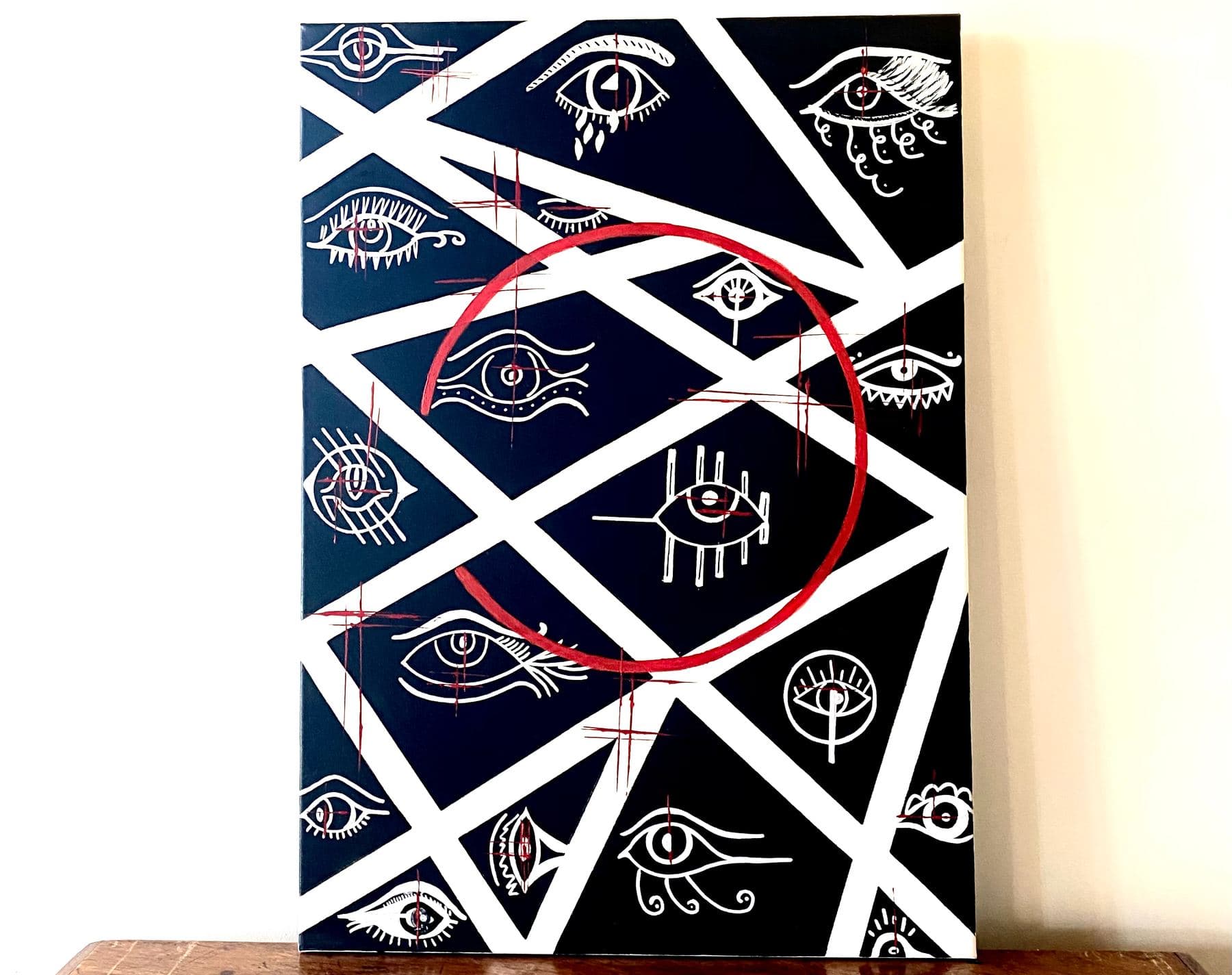
My own training, between Buenos Aires and São Paulo, owes nothing directly to Kandinsky: it runs through Torres-García and the Latin American Concrete movement, a lineage I detail in the article devoted to that history. But no twentieth-century geometric abstraction fully escapes his shadow, not even the branch that claims him the least. Torres-García himself spent many years in Europe, in contact with the ideas circulating around Kandinsky and the Bauhaus, before turning them around from Montevideo. When I paint a canvas like Regard, where a black-and-white geometric grid holds a multitude of hand-drawn eyes beneath a red circle that seems to organise everything, I find myself thinking, almost against my will, of that idea of "inner necessity": looking, behind the geometry, for a gaze that describes nothing yet feels everything. You can discover this canvas, and others where structure and emotion answer each other, in the Full Collection, and follow my upcoming exhibitions in France, Spain and Andorra on the News page.
Tags
Frequently Asked Questions
Who invented abstract painting?+
The invention of abstract painting is generally credited to Wassily Kandinsky, who painted, in Munich in 1910, what is considered the first fully abstract watercolour in the history of art — a work with no recognisable subject, built solely from colour, line and shape.
What was the Blue Rider (Der Blaue Reiter)?+
The Blue Rider was a group of artists founded in Munich in 1911 by Wassily Kandinsky and Franz Marc, after they broke away from the New Munich Artists' Association. Its 1912 almanac placed children's art and folk art on equal footing with academic painting, in service of a more inward, less academic form of expression.
What is Kandinsky's "inner necessity"?+
It's the idea, developed in his treatise Concerning the Spiritual in Art (1911), that a colour or a shape should be chosen for the emotional and spiritual charge it carries in itself, rather than to faithfully describe an object from the visible world.
What's the difference between Kandinsky and Mondrian?+
Both founded geometric abstraction, but in opposite directions: Kandinsky favoured a freer, more musical and gestural touch, while Mondrian's Neoplasticism reduced painting to a strict grid of straight lines and primary colours. I've devoted a separate article to the history of Neoplasticism and De Stijl.
Did Kandinsky teach at the Bauhaus?+
Yes, from 1922 to 1933. There he published Point and Line to Plane in 1926, analysing the visual weight of the point, the line and the plane independently of any represented subject — teaching that has shaped the grammar of geometric abstraction ever since.
Discover the works
Browse the full collection of original abstract paintings by M. C. Lamamie de Clairac.
View the Collection →