The Journal
The Bauhaus and Geometric Abstraction: How a School Changed Painting
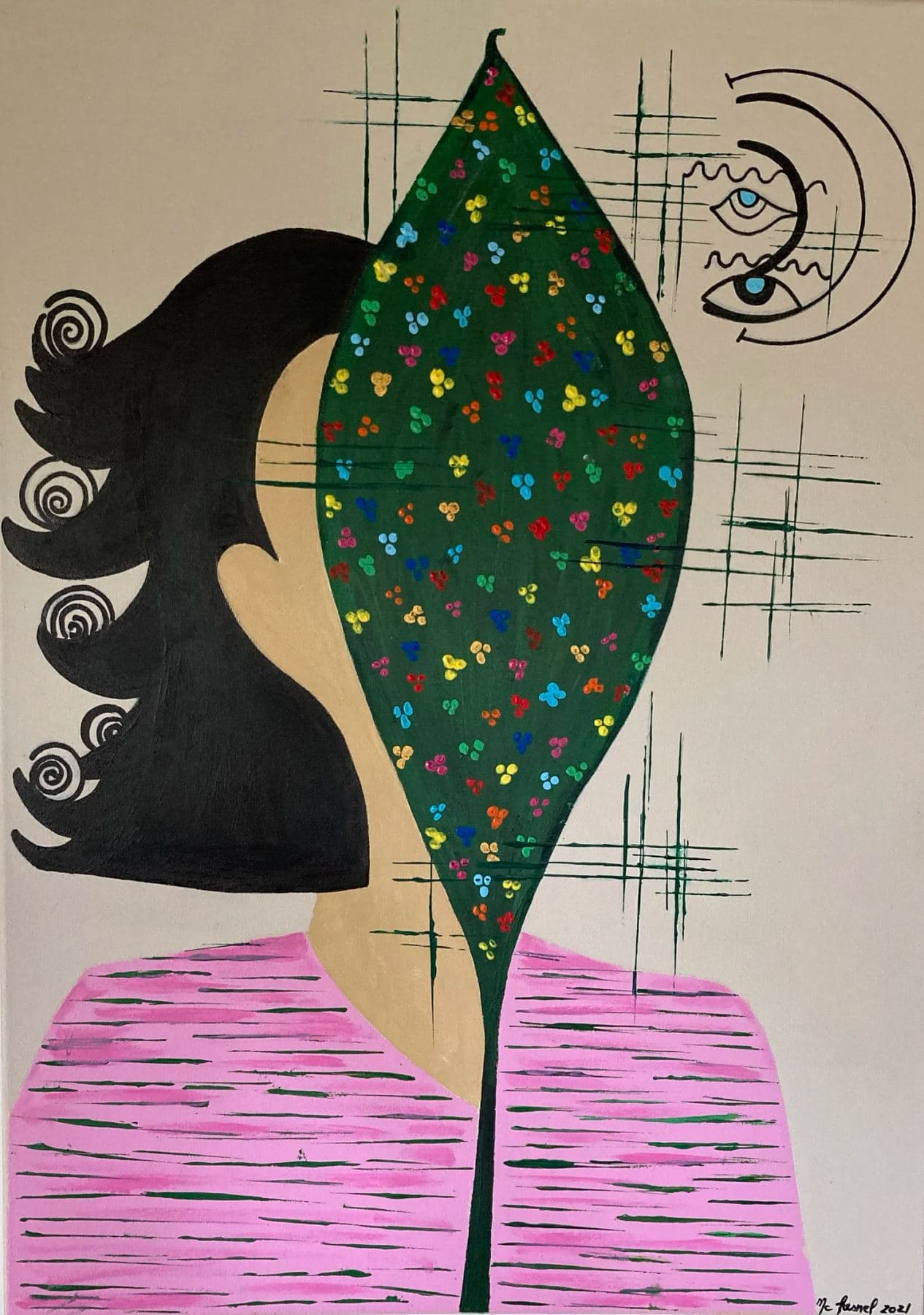
A school shut down in 1933 still dictates the visual vocabulary of geometric abstraction: clean grids, primary colours, form stripped to essentials. Here's the Bauhaus's history, its masters — Kandinsky, Klee, Itten, Albers — and what my own Latin American geometry owes it, or doesn't.
An art school shut down by the Nazis in 1933 still dictates, nearly a century later, much of the visual vocabulary of geometric abstraction: clean grids, primary colours laid down in flat, unmodulated planes, form reduced to the circle, the square and the triangle. That school was the Bauhaus. Its name gets dropped often enough — in a composition lesson, a note on colour theory — without always reckoning with just how much its short, turbulent history shaped the way geometry is painted, taught and read today. Here is that history, and what my own work does, and doesn't, owe it.
The Bauhaus was a school, not a style
The word Bauhaus, literally 'house of building', doesn't name a painting movement the way Cubism or Abstract Expressionism does — it names an art, craft and architecture school founded in Weimar, Germany, in 1919 by the architect Walter Gropius. Its founding manifesto, illustrated with a woodcut cathedral by Lyonel Feininger, set out an ambition to bring painting, sculpture, craft and architecture under one roof, training makers able to think an object — a chair, a building, a poster — through from concept to fabrication. Geometry, there, was never a style chosen for taste: it was a method, stripping form down to its simplest elements in order to rebuild it rationally.
From Weimar to Dessau: a history in three acts (1919-1933)
The Bauhaus's story fits into fourteen years and three addresses. Founded in Weimar in 1919, the school built its mandatory foundation course there, the Vorkurs, devised by Swiss painter Johannes Itten to strip students of academic reflexes before teaching them colour, material and form. In 1925, under mounting political pressure from a conservative Thuringian government, the school moved to Dessau, where Gropius himself designed the glass-walled building that still houses the Bauhaus Foundation today. It was there, between 1925 and 1932, that its teaching of geometry reached its most complete form. But the rise of Nazism caught up with the school too: driven out of Dessau in 1932, it retreated to Berlin under architect Mies van der Rohe, before dissolving itself in 1933 under pressure from the Gestapo, which judged it too close to 'cultural Bolshevism'.
Kandinsky, Klee, Itten, Albers: four masters, one shared grammar
The Bauhaus owes its lasting reach to the calibre of its teaching staff, where several generations of thinkers on form and colour crossed paths:
- —Wassily Kandinsky, who taught form theory from 1922 to 1933 and published his 1926 treatise Point and Line to Plane, analysing the visual weight of a point, a line and a plane independent of any represented subject
- —Paul Klee, who ran the stained-glass and later the weaving workshop, and developed in his Pedagogical Sketchbook a theory of movement and pictorial construction as rigorous as it was poetic
- —Johannes Itten, creator of the Vorkurs and theorist of colour contrast, whose method is still taught in most art schools
- —Josef Albers, first a student then a Vorkurs master, who carried his colour research on long after the school closed, into his Homage to the Square series begun in the United States in 1950
A grid can discipline a canvas without ever drying it out — that was the whole art the Bauhaus tried to teach, somewhere between the rigour of the gesture and the freedom of colour.
Five Bauhaus principles still visible in geometric abstraction today
Fourteen years wasn't enough to exhaust the Bauhaus's influence. A century on, several of its core choices still structure much of contemporary geometric abstraction:
- —A formal vocabulary reduced to the circle, the square, the triangle and the straight line, rather than organic or irregular shapes
- —Primary or saturated colour laid down in flat, unmodulated planes, without gradients or shading
- —Composition treated as a logical structure, where every shape occupies a justified rather than an intuitive place
- —A rejection of anecdote or narrative subject matter in favour of form and colour for their own sake
- —The idea that one geometric vocabulary can move between painting, design, typography and architecture without losing its coherence
An inheritance my own geometry didn't receive first-hand
I say this readily, including in the article I devote to Latin American geometric abstraction: my training, between Buenos Aires and São Paulo in the 1980s and 90s, doesn't descend directly from the Bauhaus. The South American concrete and neo-concrete movements that shaped me actually staked out some distance from that European model, which they judged too rational, favouring instead a more vivid colour and an openly sensory dimension. But no one paints a geometric grid without owing the Bauhaus some part of the vocabulary used to talk about it — complementary contrast, the tension of a diagonal, the balance of a composition. My own geometry, often built up with a palette knife for relief and texture, sits within a dialogue rather than a lineage: a European grammar received as an indirect inheritance, recomposed with a colour and a material that owe far more to Latin America. You can see this tension between structure and colour at work in the Full Collection, and follow which exhibitions across France, Spain and Andorra have shown these canvases on the News page.
Why the Bauhaus remains an unavoidable reference
Closed since 1933, the Bauhaus never stopped spreading. Forced into exile by the rise of Nazism, several of its masters carried their teaching to the United States: Josef Albers joined Black Mountain College and later Yale University, training a whole generation of painters in his colour theory; László Moholy-Nagy founded the New Bauhaus in Chicago. Through that American detour, as much as through books, the Bauhaus's vocabulary went on to shape the whole of twentieth-century geometric abstraction — far beyond the Germany where, under that name, it lived for barely fourteen years.
Tags
Frequently Asked Questions
What exactly was the Bauhaus?+
The Bauhaus was an art, craft and architecture school founded in Weimar, Germany, in 1919 by architect Walter Gropius. It aimed to bring painting, craft and architecture together to train makers able to think an object through from concept to fabrication, using a method built on the geometric reduction of form.
Who founded the Bauhaus, and why did it close in 1933?+
The Bauhaus was founded in 1919 by architect Walter Gropius. After moving from Weimar to Dessau in 1925 and then to Berlin in 1932 under mounting political pressure, the school dissolved itself in 1933 under pressure from the Gestapo, which judged it too close to 'cultural Bolshevism'.
What's the connection between the Bauhaus and geometric abstraction?+
Teachers such as Wassily Kandinsky, Paul Klee and Josef Albers developed a visual grammar there built on elementary geometric shapes, colour contrast and structured composition — a vocabulary still used today to analyse and create geometric abstraction.
Does M. C. Lamamie de Clairac's geometric abstraction descend from the Bauhaus?+
Not directly: her training, between Buenos Aires and São Paulo, belongs to the Latin American concrete and neo-concrete tradition, which specifically set out to distance itself from the Bauhaus's European model through more vivid, sensory colour. Even so, the geometric vocabulary she works with owes a good deal, indirectly, to that shared inheritance.
Can you still see the Bauhaus's work or legacy today?+
Yes: the Dessau building designed by Walter Gropius now houses the Bauhaus Foundation, and several German museums hold works by its masters. Its influence also shows up, more diffusely, across much of contemporary design, typography and geometric abstraction.
Discover the works
Browse the full collection of original abstract paintings by M. C. Lamamie de Clairac.
View the Collection →