The Journal
Abstract or Figurative Painting: How to Tell the Styles Apart (and What Monochrome Means)
A face half-emerges, a shape slips away, a canvas holds only one colour: abstract, figurative, semi-figurative, monochrome — I help you tell these styles apart from my studio, where I paint across all three registers.
"Is it abstract, or is that a face I'm seeing?" I get some version of that question at nearly every exhibition, standing in front of a canvas where a profile seems to surface from the paint without ever settling into a portrait. Abstract, figurative, semi-figurative, monochrome — these words come up constantly in art conversations, yet they're often muddled, or set against each other too simply. As a painter who works across all three registers from my studio in the Tarn, here are some clear markers for telling these styles apart — and for understanding why they aren't mutually exclusive.
What actually separates abstract painting from figurative painting?
Figurative painting depicts a recognisable subject — a face, a landscape, an object — even when the style strays far from photographic realism: a Cubist portrait is still figurative as long as a face can be read in it. Abstract painting, by contrast, doesn't aim to represent the visible world at all: it builds its subject purely from form, colour, line and material, with no external reference to name. Between the two lies a wide territory where both logics overlap — and that's where a good deal of contemporary art, including part of my own work, takes root.
Between the two: what is semi-figurative painting?
Semi-figurative painting suggests a subject without fully describing it: a sketched-in silhouette, a gaze emerging from the composition, a recognisable posture within a tangle of form. That tension between reading a subject and losing it runs through much of 20th-century art history, from Cubism, which fragments the face without erasing it, to Expressionism, which distorts the figure to intensify its emotion. It's also the territory I place canvases like Armure d'Enfant or Double Visage in: a human figure can be sensed in them, but never fully, leaving whoever is looking free to reconstruct it in their own way.
Monochrome: a painting with almost no colour, but never without a subject
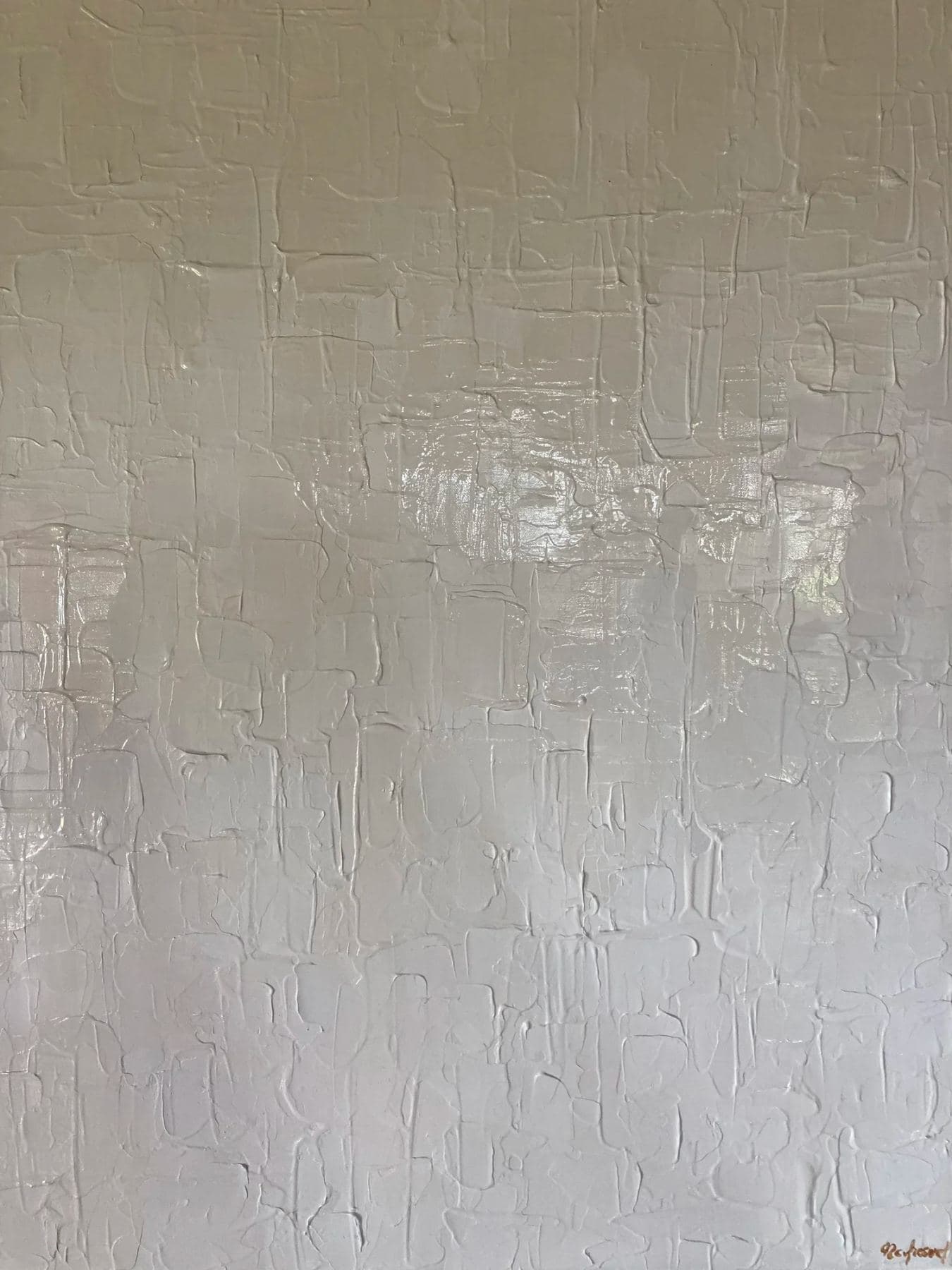
Monochrome deliberately narrows the palette to a single colour, or to very close variations of one hue. It's often associated with abstraction — and that is indeed the most common case — but nothing stops a monochrome from staying figurative if a recognisable form still emerges within it. With no chromatic contrast to guide the eye, the material itself becomes the subject: the thickness of the paint, the grain left by a palette knife, the ridges and hollows that catch the light differently depending on the time of day. My canvas Blanc Immaculé, worked entirely with a palette knife in a range of whites and creams, works exactly this way: with no colour to tell a story, texture takes over instead.
Five things to look for to tell a painting's style at a glance
- —A subject you can name at first glance (a face, a body, a landscape) signals figurative painting, even in a stylised form
- —A recognisable shape that slips away the closer you look usually points to a semi-figurative composition
- —A palette narrowed to a single hue, with no colour cue to follow, points to monochrome work — abstract or not
- —Thick, knife-worked paint rather than brushwork shifts attention from colour toward relief and light
- —A literal title (a place, a named face) usually goes with figurative work; an evocative or abstract title (an emotion, a concept) usually goes with abstraction
I never choose a style before starting a canvas — it's the paint itself, as it dries, that decides whether a face should appear or dissolve.
Inside my studio: why I paint across three registers — abstract, monochrome and figurative
My work is usually described as bold, colourful geometric abstraction, rooted in my training between Buenos Aires and São Paulo — and that's true of a large share of my canvases. But the Full Collection, filterable by category, also reveals a more figurative side to my practice: faces that can be sensed in La Fiancée, Regard or Silhouette Rouge, a child's armour suspended between portrait and symbol in Armure d'Enfant, and the near-monochrome restraint of Blanc Immaculé and Brume. I don't treat these registers as competing directions, but as different tools in service of the same pursuit: finding, canvas after canvas, the truest balance between material, colour and emotion. You can explore all three families of work — colourful, monochrome and figurative — in the Full Collection, and see the exhibitions across France, Spain and Andorra where several of these canvases have been shown on the News page.
Tags
Frequently Asked Questions
What's the difference between an abstract painting and a figurative painting?+
A figurative painting depicts an identifiable subject — a face, a body, a landscape, an object — even in stylised form, while an abstract painting builds its subject purely from form, colour and material, without representing anything from the visible world.
What is semi-figurative painting?+
It's a painting in which a recognisable subject — often a silhouette or a face — can be sensed without ever being fully described, sitting midway between a figurative reading and the freedom of abstraction.
What is monochrome painting, and is it always abstract?+
A monochrome painting uses a single colour, or very close variations of one hue. It's most often abstract, with material and texture standing in for chromatic contrast, but nothing prevents a monochrome from staying figurative if a recognisable form still appears within it.
Can you enjoy both abstract and figurative art?+
Absolutely — they're two different languages, not opposing camps. Many collectors combine abstract, semi-figurative and figurative canvases within the same room, playing with contrasts in style rather than sticking to a single register.
Why do you paint abstract, monochrome and figurative work all at once?+
Because every canvas asks for something different: some call for the total freedom of colour and geometry, others for the restraint of a knife-worked monochrome, and others for the quiet presence of a human figure. You can see all three registers in the Full Collection.
Discover the works
Browse the full collection of original abstract paintings by M. C. Lamamie de Clairac.
View the Collection →