The Journal
The Title of an Abstract Painting: How (and Why) I Name My Work
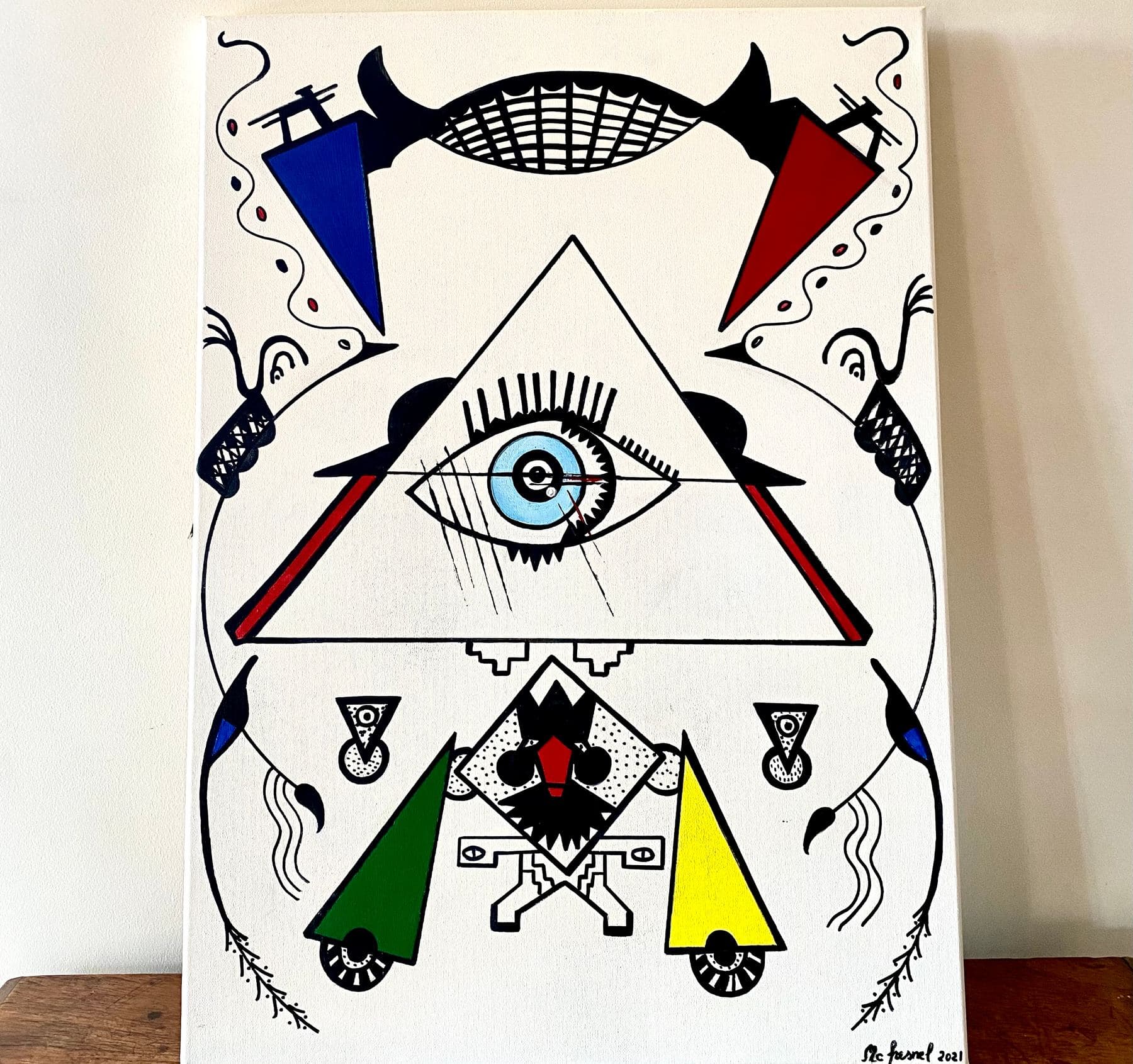
"Why is it called that?" At exhibitions, the question comes up almost as often as the price. Neutral titles, feeling-titles, or evocative titles in Spanish and Latin: here's how I name my paintings, and what a title actually changes in how an abstract work is read.
"Why is your painting called Viracocha?" "What does Omniscius Oculus mean?" At exhibitions, these questions come up almost as often as ones about technique or price — and they make sense. Unlike a still life or a portrait, an abstract painting doesn't carry its subject on the canvas, so why give it a title at all, and why that one rather than another? Between artistic convention, personal gesture and cultural heritage, here's how the title of an abstract work gets chosen — and how I choose mine.
Why does an abstract painting have a title at all?
You might assume that abstraction, having freed itself from a represented subject, would also free itself from the need to name the work. That's partly true: a wide strand of abstract art, from Rothko to much of contemporary practice today, prefers the neutral 'Untitled' followed by a number or date, precisely so as not to steer the viewer's eye. But an equally old tradition does the opposite: Kandinsky, a pioneer of abstraction, titled some canvases 'Composition' or 'Improvisation' followed by a number, keeping that same neutrality, yet named others in an almost poetic way. Joan Miró, for his part, embraced fully evocative titles, sometimes closer to a line of poetry than a caption. There is no single rule, then — two traditions have coexisted since abstraction's beginnings, and every artist picks a side, or moves between the two.
Three ways to name an abstract work
- —The neutral or coded title — 'Untitled No. 12', a date, a series number — sets no direction for the eye and leaves all the room to the viewer's own experience
- —The feeling-title — a word naming the emotion or gesture felt once the work is done, like Tempête (Storm), Mouvement (Movement) or Équilibre (Balance) — it extends the canvas without translating it
- —The evocative or cultural title — a mythological reference, a Latin or Spanish word, a personal nod — it opens one possible door in, without ever imposing it as the only valid reading
What a title changes — and doesn't change — in how a work is read
A title is never a caption. Unlike a figurative painting, where the title usually confirms what the eye already sees, an abstract title works like a door left ajar: it suggests a direction without closing around it. Two people can look at the same canvas titled Mar Azul and one might see a literal evocation of the sea, while the other feels a sense of calm or depth with nothing maritime about it — both readings remain equally valid. That freedom is exactly what sets abstraction apart from figurative painting: the title walks alongside the eye, it doesn't lead it.
How I choose the title of my paintings
In my own work, the title almost always comes after the canvas, never before. I don't start from an idea to illustrate — I start from a gesture, a colour, a relationship of material built up with the palette knife, and only once the painting is finished do I look for the word that fits it, often the one that best describes what I feel looking at it, or what it recalls from my years of training between Buenos Aires and São Paulo. That's the source of a habit that shows up again and again in my titles: Spanish, and more rarely Latin, two languages that are as much a part of my history as my painting is.
- —Viracocha — a creator deity in Andean and Inca cosmology; chosen for a figurative canvas whose presence felt almost mythological
- —Omniscius Oculus — Latin for 'the all-seeing eye'; a title found for a canvas where a gaze seemed to emerge from the composition itself
- —Mar Azul — Spanish for "blue sea"; a direct nod to my years in Latin America, for a canvas dominated by deep blues
- —Criaturas — Spanish for "creatures"; for a canvas where colour and figure seemed to take on a life of their own during the process
- —Ijometry — a personal play on the word 'geometry', for a canvas where the geometry bends slightly out of true, like a wink at its own rules
I never choose a title to explain a painting — I choose it to give the work a second life, once the first one, the life of colour and gesture, is already complete.
The title as a conversation starter at exhibitions
A painting's title is often what opens the conversation at an exhibition, even more than technique or format. Standing in front of Viracocha or Criaturas, visitors spontaneously ask what they mean, which almost always leads me to talk about the painting's context too — when it was made, the technique used, sometimes the exhibition it was prepared for. It's one of the reasons I prefer to sell my work directly rather than through a gallery: the title becomes a starting point for talking about the piece itself. If a title has caught your curiosity, you can find its story and the canvas that carries it in the Full Collection, or come ask me in person at an upcoming exhibition in France, Spain or Andorra, listed on the News page.
Tags
Frequently Asked Questions
Why are some abstract paintings called 'Untitled'?+
Because some artists prefer not to steer how a work is read: a neutral title, followed by a number or date, leaves the viewer entirely free to form their own interpretation. It's a tradition just as legitimate as evocative titles — an aesthetic choice, not an absence of one.
Should the title of an abstract painting be taken literally?+
Rarely. A title like Mar Azul or Viracocha offers one possible way in, not an exact description of what's painted. Two viewers can walk away with different readings, and both remain valid.
Why do your paintings often carry Spanish or Latin titles?+
Because those languages are part of my personal history: I trained in painting, ceramics and pottery between Buenos Aires and São Paulo during the 1980s and 1990s. Spanish or Latin titles come naturally, more as an extension of that training than a calculated aesthetic choice.
Is a painting's title chosen before or after it's painted?+
In my case, almost always after. I never start from a title to illustrate — the canvas is built first through colour and gesture, and the title comes afterward, once the finished work suggests the word that fits it.
Does the title of an abstract work affect its value?+
Not directly — format, technique and rarity matter more. But a well-chosen title makes a painting more memorable and makes it easier to talk about, which also matters in the relationship between a collector and a work.
Discover the works
Browse the full collection of original abstract paintings by M. C. Lamamie de Clairac.
View the Collection →